
Cognitive Speed Diagnostic
Measure your pure neural transmission, visual filtering, and cognitive flexibility in a 60-second scientific battery.
How Fast Is Your Brain, Really?
We often talk about “brain power,” but rarely do we talk about brain speed.
Your brain’s processing speed is the rate at which your brain takes in information from your senses, processes it, and makes a decision. It’s the hidden engine behind your focus, your reflexes, and your ability to multitask.
This Brain Speed Test measures three distinct components of your cognitive processing speed in just 60 seconds. Let’s look at what each stage reveals about your mental hardware.
The Three Pillars of Cognitive Speed
This diagnostic doesn’t just give you one score. It breaks down your speed into three critical areas.
1. Neural Transmission (Reaction Time)
The first stage measures your pure reaction time. This is the time it takes for a visual signal (the green light) to travel from your eyes to your brain and down to your finger.
This is your baseline hardware speed. Faster reaction times are linked to better coordination and general alertness. It’s the raw speed of your nervous system.
2. Visual Filtering (Choice Speed)
The second stage is more complex. You aren’t just reacting; you are filtering. You had to find the blue target among the decoys.
This measures your brain’s ability to ignore distractions and locate relevant information. In the real world, this is the skill you use when trying to find a friend in a crowded room or spotting a specific file on a messy desktop.
3. Inhibitory Control (The Stroop Effect)
The third stage is the hardest. This is the famous Stroop Test. You were asked to name the color of the ink, not the written word.
When the word says “RED” but the ink is “Blue,” your brain experiences interference. The reading center of your brain (which is very fast) screams “RED,” while your logic center tries to say “Blue.”
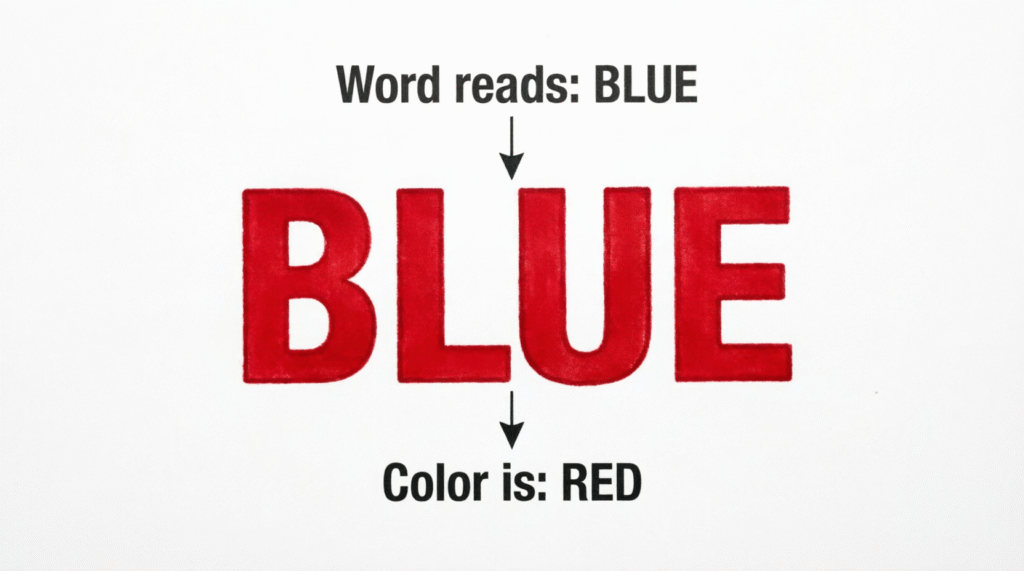
Why does this matter? This measures your executive function—your ability to inhibit a strong impulse to do what is actually required. High scores here mean you have excellent mental discipline and flexibility.
Why Brain Speed Declines
If your score was lower than expected, you aren’t alone. Cognitive speed naturally peaks in our 20s and slowly declines. However, lifestyle factors play a massive role.
- Sleep Deprivation: Lack of sleep significantly slows reaction times and impairs the prefrontal cortex (which handles inhibitory control). If you are tired, your scores will reflect it. Use our sleep need calculator to ensure you are getting the rest your brain needs to fire quickly.
- Stress: High stress floods the brain with cortisol, which can interfere with the communication between neurons, leading to “brain fog” and slower processing.
- Lack of Practice: Just like a muscle, the brain follows the “use it or lose it” rule. If you don’t challenge your brain with new stimuli, your processing pathways can become less efficient.
How to Improve Your Score
The good news is that cognitive speed is trainable. You can sharpen your reflexes and mental flexibility with consistent practice.
1. Train Your Focus
Improving your ability to focus directly improves your visual filtering speed. Using a study focus timer can help you practice sustained attention, which trains your brain to process information faster without getting distracted.
2. Physical Exercise
Cardiovascular exercise increases blood flow to the brain, specifically to the hippocampus and prefrontal cortex. Just 20 minutes of brisk walking can temporarily boost processing speed.
3. Play Strategy Games
Fast-paced video games or strategy games like Chess force your brain to constantly filter information and make decisions under pressure, which directly trains the skills measured in Stage 2 and 3.
Frequently Asked Questions
What is a “good” score? An average score for a healthy adult is typically between 300-450ms on this combined test. “Elite” scores (under 280ms) indicate very high processing speed, often seen in professional gamers or athletes. Scores above 500ms may suggest fatigue or need for practice.
Does brain speed mean intelligence? Not necessarily. While processing speed is one component of intelligence (often called “fluid intelligence”), it isn’t the whole picture. A slower thinker might have deeper analytical skills. Speed is just one measure of efficiency.
Why was the Stroop test so hard? The Stroop test creates a conflict between two parts of your brain. The automatic part (reading) is faster than the controlled part (naming the color). You have to use “executive control” to override the automatic response. This is why it feels like a mental workout.
Can I retake the test? Yes. However, you might get faster simply because you know what to expect. For an accurate measure of improvement, wait a day or two before retaking it.
Does age affect brain speed? Yes. Neural transmission speed naturally slows slightly with age. However, staying mentally active, eating a healthy diet, and managing stress can keep this decline minimal.
Disclaimer: This test is for educational and entertainment purposes. It is not a medical diagnostic tool. If you notice sudden changes in your cognitive ability or reaction times, please consult a healthcare professional.
Written by Sharjeel — Founder, WikipediaSearch