Did Scientists Finally Capture the “Light of the Soul”? The Real Science Explained
Discover the 2009 Japanese experiment that measured a faint glow from living bodies that disappears after death. The real science of biophotons — no hype, just facts.
The Quick Science in 60 Seconds
Every living cell emits tiny amounts of light called biophotons.
These are ultra-weak photons — far too faint for our eyes to see.
The light is strongest in healthy, active bodies.
It drops dramatically within minutes of death.
It’s not heat, electricity, or magic — it’s a natural byproduct of cellular metabolism.
Science explains it clearly, but it still raises deep questions about life and consciousness.
We’ve all heard stories of a mysterious glow or aura leaving the body at the moment of death. Viral videos and headlines claim scientists have finally photographed the human soul. But what’s actually happening inside a living body that creates this faint light — and does it really vanish when we die?
In 2009, a Japanese researcher at Tohoku University decided to find out. Using ultra-sensitive cameras, Masaki Kobayashi measured something extraordinary: a faint glow coming from living human bodies that disappears shortly after death. This isn’t body heat or imagination — it’s real, measurable light. Today, this phenomenon is called biophoton emission, and it’s sparking fresh curiosity about life, death, and what makes us “alive.”
The Quick Science in 60 Seconds Every living cell emits tiny amounts of light called biophotons. These are ultra-weak photons — far too faint for our eyes to see. The light is strongest in healthy, active bodies. It drops dramatically within minutes of death. It’s not heat, electricity, or magic — it’s a natural byproduct of cellular metabolism. Science explains it clearly, but it still raises deep questions about life and consciousness.
That’s the big picture. Let’s look at the real experiment and what it actually means.
The Japanese Experiment That Started It All
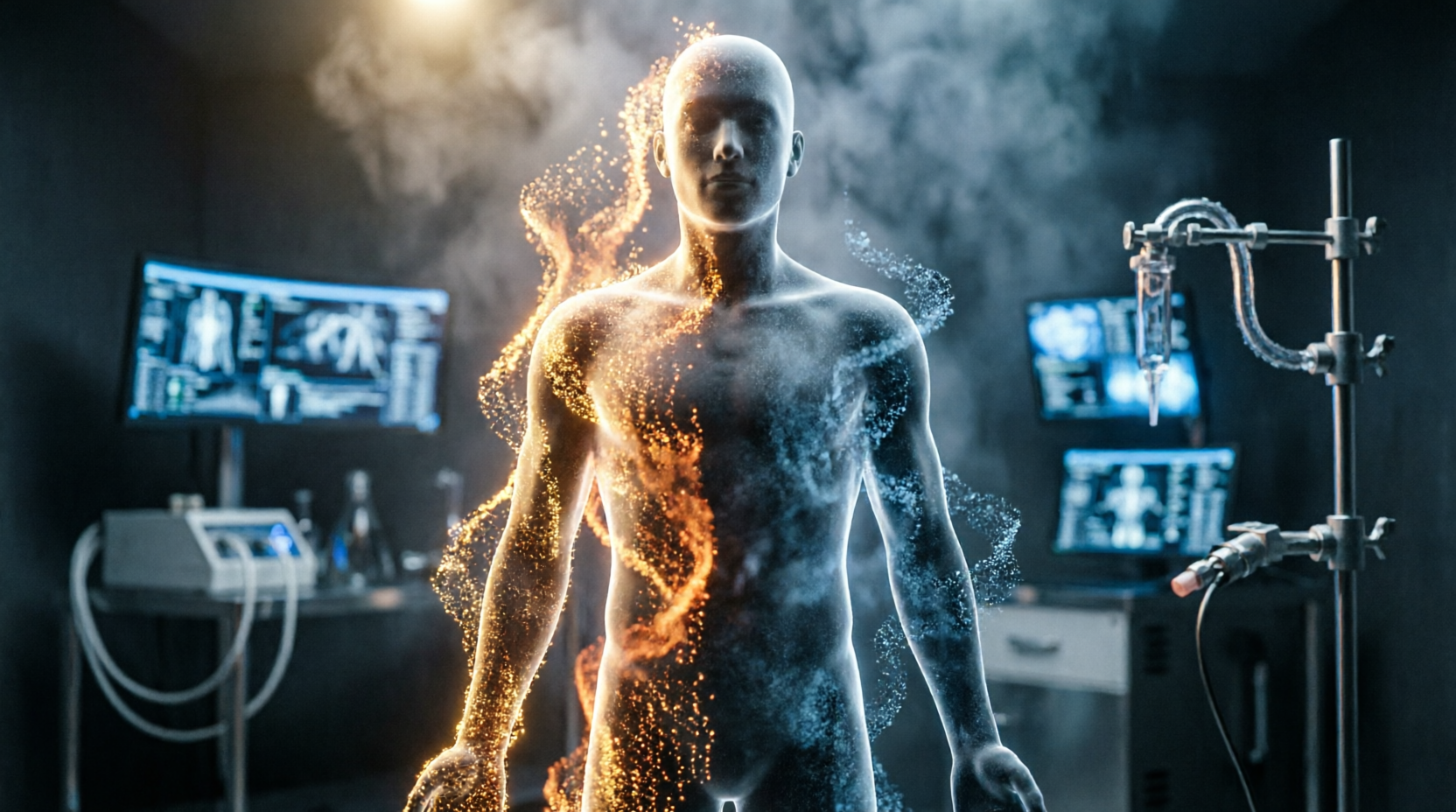
Back in 2009, Masaki Kobayashi and his team at Tohoku University built a special dark room with ultra-sensitive photon detectors. They placed volunteers inside and measured the faint light coming from their skin and bodies.
What they found was consistent: living people emit a steady stream of ultra-weak photons. These photons are produced by the chemical reactions happening inside our cells every second. When the same measurements were taken on bodies shortly after death, the light almost completely disappeared.
The glow wasn’t caused by body heat or external light leaking in — the equipment ruled those out. It was internal, natural, and tied directly to being alive.
Watch the full story of this groundbreaking experiment here:
What Are Biophotons and Why Do We Emit Them?
Biophotons are not “soul light.” They’re real photons (particles of light) produced when our cells carry out normal metabolism — especially when reactive oxygen species interact with molecules inside cells.
Every living organism — plants, animals, humans — emits them. The stronger the metabolic activity, the brighter the emission. Healthy cells glow more; stressed or dying cells glow less.
This light is extremely weak — about 1,000 times fainter than what our eyes can detect — which is why it stayed hidden until modern sensitive cameras were invented.
Does This Prove the Existence of a Soul?
No. The science is clear: the glow is a natural physical process, not evidence of a soul leaving the body. It stops because metabolism stops. No more chemical reactions, no more photons.
However, the experiment does raise fascinating questions about consciousness and the boundary between life and death. It shows how incredibly complex and “lit up” our bodies are even at the tiniest level.
Many scientists see it as beautiful proof of how alive we really are — not supernatural proof, but a reminder of the wonder inside every cell.
Why This Matters in Everyday Life
Understanding biophotons reminds us that life is a continuous, glowing process. Small choices that support cellular health — good sleep, nutrition, reduced stress — literally keep our inner light brighter.
It also encourages humility: there are still mysteries in the human body that science is only beginning to explore.
Curious to explore more about how your brain and body work together? Check out our Brain Focus Science category or try the free Sleep Need Calculator to see how rest affects your body’s natural rhythms.
Common Misunderstandings
- “The glow is the soul leaving” — The light is produced by living cells and fades when cells stop working.
- “Only special people glow” — Every living human emits biophotons; the equipment just makes it visible.
- “This is new science” — Biophoton research has existed for decades; Kobayashi’s work brought new attention.
- “It proves life after death” — The experiment measures physical processes in the body, not consciousness after death.
- “The light is the same as an aura in spiritual traditions” — The scientific glow is measurable photons; spiritual auras are a different concept.
FAQ
How strong is this light? Extremely weak — you need special cameras to detect it. It’s not visible to the naked eye.
Does everyone emit the same amount? Healthy, active people tend to emit more. Stress, illness, or death reduces it quickly.
Can we increase our biophoton emission? Supporting overall health through diet, sleep, and exercise helps maintain normal cellular activity.
Is this the same as Kirlian photography? No. Kirlian photography captures electrical discharges; biophotons are actual light particles from metabolism.
Should I worry about this for health? Not at all. It’s a normal part of being alive. Focus on everyday healthy habits instead.
Written by Sharjeel — Founder, WikipediaSearch [Last Updated: April 2026]
Disclaimer: This article is for educational purposes only and does not constitute medical or professional advice. It discusses scientific research and does not replace professional health guidance.
Author Note: Written by Sharjeel — Founder, WikipediaSearch