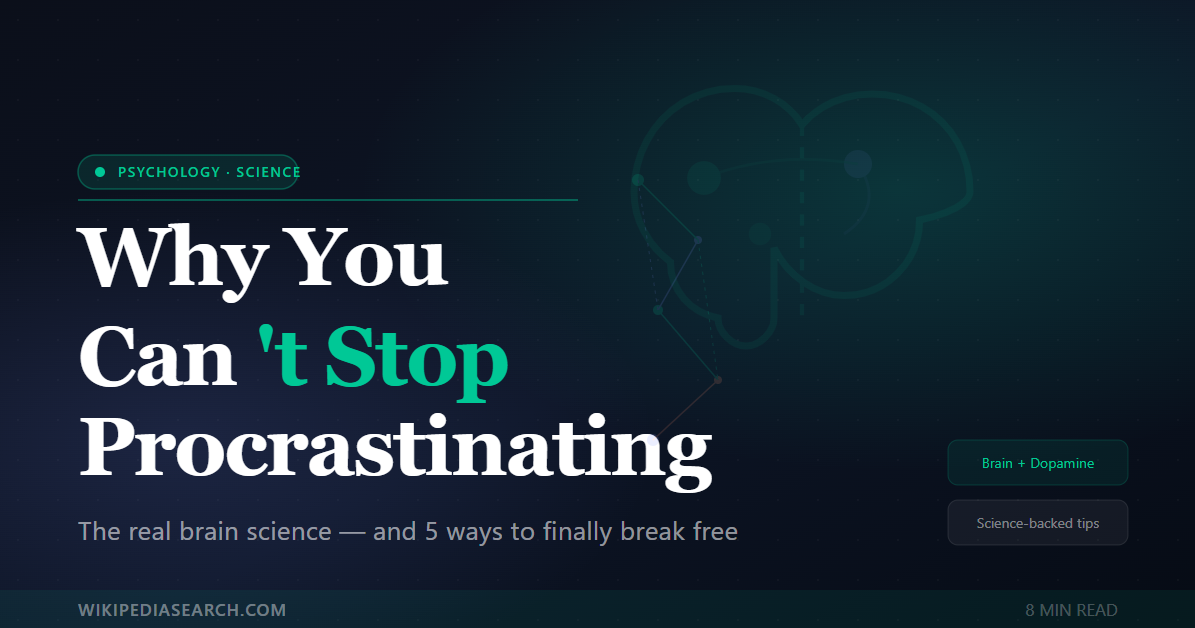
Why You Can’t Stop Procrastinating
Why You Can’t Stop Procrastinating — The Real Brain Science (And 5 Ways to Fix It)
Procrastination isn’t laziness. It isn’t poor time management. It isn’t even a bad habit. It’s your brain doing exactly what it was designed to do — and that’s why willpower alone will never beat it.
You have a deadline. You know it. Your body knows it. And yet — you’re watching YouTube, reorganizing your desk, or suddenly deciding the kitchen needs cleaning right now.
Sound familiar? You’re not broken. According to neuroscience, 92% of people procrastinate regularly, and for 20% it’s a chronic problem that affects their health, relationships and career.
This article explains exactly what happens inside your brain when you procrastinate — and gives you five evidence-based techniques to rewire that pattern starting today.
What is actually happening in your brain
Your brain has two systems constantly fighting for control over your decisions. Think of them as two characters:
Character 1: The Prefrontal Cortex — the rational, long-term thinker. It knows the report is due Friday. It knows the consequences. It wants to start now.
Character 2: The Limbic System — the emotional, pleasure-seeking, survival-focused ancient brain. It doesn’t think about Friday. It thinks about right now. And right now, scrolling Instagram feels a lot better than writing that report.
The key insight: Procrastination is not a time-management problem. It is an emotional regulation problem. When a task feels uncomfortable, threatening, or overwhelming, your limbic system overrides your prefrontal cortex and pushes you toward anything that feels better — immediately.
Brain scans of chronic procrastinators show measurably reduced activity in the prefrontal cortex and an oversized amygdala — the fear and emotion-processing centre. Their brains are literally more sensitive to negative emotions associated with difficult tasks.
The dopamine problem nobody talks about
Here’s where it gets interesting — and where most advice gets it completely wrong.
Dopamine is your brain’s motivation currency. It’s released not just when you get a reward, but when you anticipate one. This is why your phone is so powerful: every notification, every scroll, every refresh is a tiny dopamine hit. Your brain learns to crave the possibility of reward.
The Science
Research published in WIREs Cognitive Science found that procrastination is driven primarily by emotional dysregulation, not poor time management. When we anticipate discomfort from a task, the amygdala signals “threat” — and the brain routes us toward anything that soothes that discomfort immediately, usually fast-dopamine sources like social media.
The problem is a feedback loop: the more you choose fast dopamine (phone, Netflix, snacks) over slow reward (deep work, exercise, building something meaningful), the more desensitised your brain becomes to slow rewards. Deep work starts to feel unbearably boring. The motivation to do hard things quietly evaporates.
You’re not lazy. Your dopamine system has been hijacked by things engineered specifically to hijack it.
The procrastination-perfectionism trap
There’s one type of procrastinator who never gets talked about: the high achiever.
Perfectionism and procrastination are deeply linked. When you set standards that are too high, starting feels dangerous. What if you don’t do it perfectly? What if people judge you? What if you fail?
The amygdala registers this anticipated failure as a social threat — and for humans, social rejection has historically been life-threatening. So your ancient brain protects you by making you not start. If you never try, you can never fail.
The cruel irony: Procrastinating to avoid failure guarantees a worse outcome than trying imperfectly would have. The perfectionist brain knows this logically — but emotions don’t follow logic.
Research on students found that perfectionists were significantly more likely to procrastinate — not because they didn’t care, but precisely because they cared too much. The higher the stakes felt, the harder it was to start.
Why “just do it” advice doesn’t work
Motivational advice — “just start,” “stop making excuses,” “discipline over motivation” — misunderstands the problem at a fundamental level.
You can’t willpower your way out of a neurochemical pattern. It’s like telling someone with a broken leg to just walk it off.
What actually works is understanding the brain’s own systems and working with them, not against them. The five strategies below are all based on this principle — they work by changing the emotional equation, not by demanding more willpower.
5 science-backed ways to actually stop procrastinating
The 2-minute rule (reduce friction to zero)
The brain’s biggest barrier to starting is the emotional weight of the full task. Strip it away. Your only rule: do 2 minutes and then you’re allowed to stop. The prefrontal cortex can override the limbic system for 2 minutes far more easily than for 2 hours. And once you start, momentum takes over — the brain releases a small dopamine reward for task initiation, making it easier to continue. Studies show that simply beginning a task reduces anxiety about it by up to 40%.
Make the task emotionally safer (shrink the stakes)
If perfectionism is the trigger, reframe what you’re doing. You’re not “writing the report” — you’re writing a terrible first draft. You’re not “starting a business” — you’re spending 20 minutes brainstorming. Shrinking the emotional stakes reduces the amygdala’s threat response and allows your prefrontal cortex to engage. Research in behavioural therapy shows that reframing tasks as exploratory rather than evaluative significantly reduces avoidance behaviour.
Create a dopamine reward structure for deep work
Your brain won’t stop seeking dopamine — so give it a legitimate source. After every 25 minutes of focused work (a Pomodoro), take a genuine, deliberate break that you actually enjoy. Walk. Coffee. Music. Not phone scrolling — that resets your focus back to zero. This trains your brain to associate deep work with dopamine reward, gradually making productive work feel more appealing than procrastination. Over weeks, this actually changes the brain’s baseline preference.
Add friction between you and distractions
Ease of access is everything for the dopamine-seeking brain. Every second of friction reduces the chance you’ll choose distraction. Log out of social media accounts (don’t just close the tab). Put your phone in another room. Use a website blocker. Researchers found that people who kept their phones on their desk scored measurably lower on cognitive tests than those who left phones in another room — even with the phone face down and on silent. Its mere presence drains attention.
Use implementation intentions (be brutally specific)
“I’ll work on the project tomorrow” is not a plan — it’s a wish. Your brain needs specificity to override the limbic system’s preference for comfort. The exact format that works: “I will [specific action] at [specific time] in [specific place].” Example: “I will write the introduction of my report at 9am at my desk before opening email.” Studies show that people who write implementation intentions are 2–3 times more likely to follow through than those who set vague goals. The specificity creates a mental shortcut that bypasses the moment of hesitation where procrastination wins.
The deeper truth: procrastination is emotional, not moral
The most important shift you can make is this: stop seeing procrastination as a character flaw. It isn’t one. It’s a predictable output of how human brains are wired in an environment they were never designed for.
Our brains evolved over millions of years to respond to immediate threats and immediate rewards. The modern world — with its deadlines, notifications, social comparison, infinite content — is neurologically hostile to deep, slow, meaningful work.
Understanding this doesn’t remove responsibility. But it replaces shame with strategy. And strategy is something you can actually act on.
The key takeaway: The people you admire who “never procrastinate” aren’t stronger or more disciplined than you. They’ve simply built systems, environments and habits that make it easier for their brain to choose the hard thing. You can build those same systems.
Start with two minutes. Set a specific time. Remove one source of distraction from your desk right now. Small interventions in the environment produce lasting changes in behaviour — because they work with your neurobiology, not against it.
Key takeaways from this article
- Procrastination is an emotional regulation problem, not a time-management problem
- Your limbic system overrides your prefrontal cortex when tasks feel threatening
- Dopamine hijacking by social media makes slow rewards feel increasingly unappealing
- Perfectionism amplifies procrastination by raising the emotional stakes of starting
- The 2-minute rule, shrinking stakes, and implementation intentions work because they reduce limbic system activation
- Environment design (removing friction to work, adding friction to distractions) is more powerful than willpower