
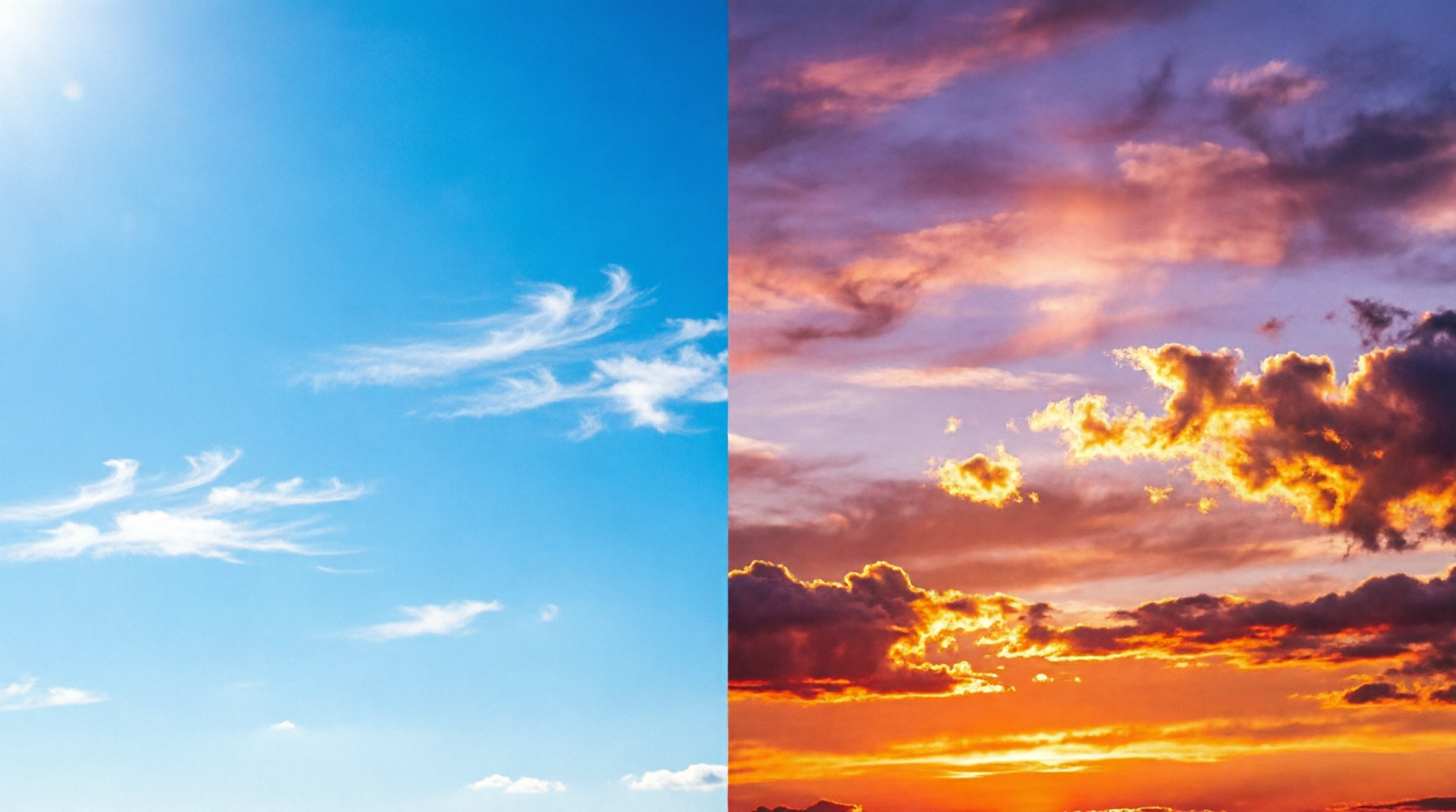
Why the Sky Is Blue: The Simple Science Explained
Discover the simple science of why the sky is blue. Learn about Rayleigh scattering, light wavelengths, and why sunsets are red in this easy guide.
It is one of the first questions we ask as children: “Why is the sky blue?” The answer isn’t as simple as “it reflects the ocean.” In fact, the ocean is blue for some of the same reasons the sky is blue.
The real reason lies in how sunlight interacts with the blanket of air surrounding our planet. It is a physics phenomenon that happens every single second of the day.
🚿 The “Midnight Cleaning Crew”
During deep sleep, your brain cells physically shrink by up to 60%. This opens up tiny channels for cerebrospinal fluid (CSF) to rush through, washing away toxic proteins like beta-amyloid that accumulate during the day. If you don’t get enough deep sleep, this “trash” stays in your brain, potentially leading to brain fog and long-term cognitive decline.
Sunlight: The Hidden Rainbow
To understand the sky, you first have to understand the light coming from the sun.
Sunlight looks white or yellow to our eyes. However, it is actually made up of all the colors of the rainbow mixed together. Each color travels as a wave, but these waves are different sizes.
- Red light has long, lazy waves.
- Blue light has short, choppy waves.
When sunlight enters Earth’s atmosphere, it doesn’t just sail through empty space. It has to pass through layers of gas molecules—mostly nitrogen and oxygen. This is where the trouble starts for blue light.
Rayleigh Scattering: The Bouncing Blue Waves
Imagine running through a crowded room. If you run with your arms wide (a long wave), you might brush past people but keep moving forward. If you run erratically with short, fast steps (a short wave), you are going to bump into people and bounce all over the place.
This is exactly what happens in the atmosphere.
The gas molecules act like the people in the room.
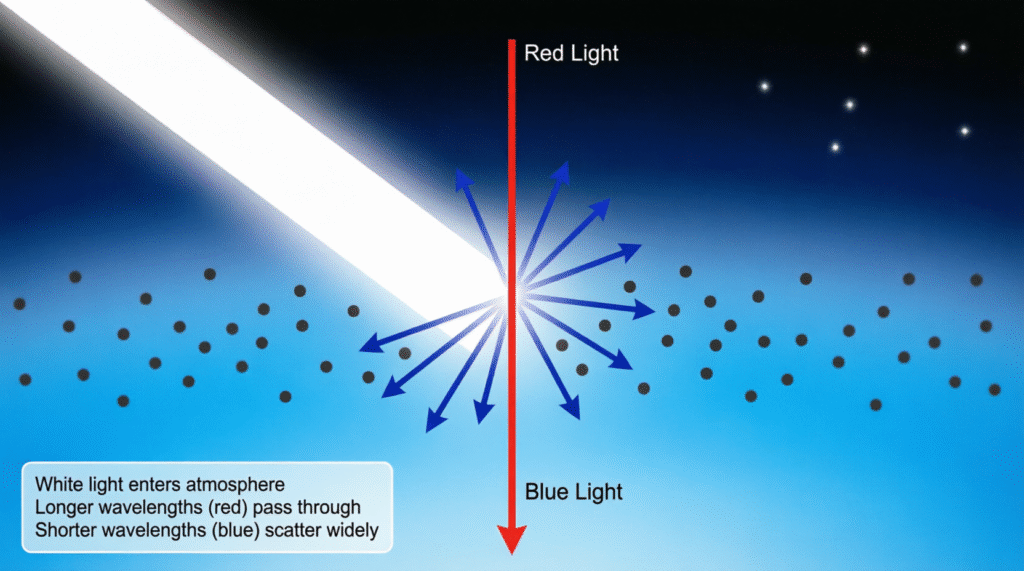
- Red light (long waves): Passes straight through the gas molecules. It barely interacts with them.
- Blue light (short waves): Crashes into the gas molecules and scatters, or bounces, in every direction.
This bouncing effect is called Rayleigh Scattering. Because blue light is scattered all over the sky, when you look up, your eyes catch that scattered light coming from every angle.
Why Not Violet?
If short wavelengths scatter the most, you might wonder why the sky isn’t violet. Violet light has an even shorter wavelength than blue.
There are two main reasons:
- The Sun: The sun doesn’t emit as much violet light as it does blue light.
- Our Eyes: Human eyes are much more sensitive to blue than to violet. Our brain interprets the mix of scattered violet and blue as simply “blue.”
Why Sunsets Are Red
If the sky is blue during the day, why does it turn red and orange at sunset?
It is the same scattering effect, but with a different angle.
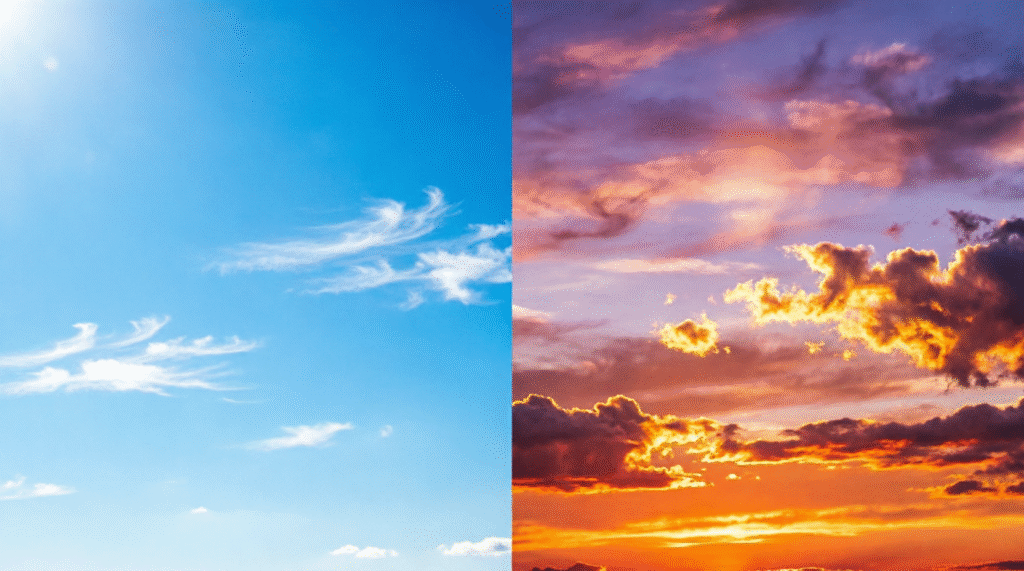
When the sun is low on the horizon, the light has to travel through a much thicker slice of the atmosphere to reach your eyes. By the time it gets to you, all the blue light has been scattered away into space. Only the red, orange, and yellow light—those long, lazy waves—are able to punch through the long distance and reach your eyes.
Why This Matters
Understanding why the sky is blue is a perfect introduction to how our world works physically. It explains why:
- The Ocean is Blue: Water absorbs red light, leaving mostly blue light to be reflected and scattered. It’s not just mirroring the sky!
- Space is Black: There is no atmosphere to scatter light, so the sky looks black even when the sun is shining.
Science isn’t just for textbooks. It explains the very canvas of our daily lives. If you enjoy testing your knowledge of the world, you can try our simple science quiz to see how much you know about everyday phenomena.
Common Misunderstandings
Myth 1: The sky is blue because it reflects the ocean. False. While the ocean is blue, the sky would still be blue even if the Earth had no oceans. It is the atmosphere that creates the color.
Myth 2: The sky is blue due to water vapor. False. Rayleigh scattering is caused by nitrogen and oxygen molecules. Water droplets (clouds) are much larger and scatter all light equally, which is why clouds look white or gray.
Myth 3: Space is black because it’s night. Space is black because there are no gas molecules to scatter sunlight.
Myth 4: The sun is yellow. The sun is actually white. It only appears yellow from the ground because the atmosphere scatters away the blue light, leaving a yellowish tint.
Frequently Asked Questions
Does the sky look blue from space? No. Astronauts see a black sky with a bright white sun. Without an atmosphere to scatter light, there is no color in the “sky.”
Why is the sky sometimes gray? On hazy or polluted days, larger particles (like dust or water droplets) scatter all colors of light equally. This washes out the blue, making the sky appear grayish-white.
Is the sky blue on other planets? It depends on their atmosphere. Mars has a thin atmosphere of carbon dioxide, which scatters light differently—sunsets on Mars appear blue, and the daytime sky is butterscotch or pinkish.
Can animals see the blue sky differently? Yes. Some animals, like birds and bees, can see ultraviolet light. They might see patterns or colors in the sky that humans cannot perceive.
Is Rayleigh scattering why the ocean is blue? Partially. Water molecules scatter blue light too, but water also absorbs red light wavelengths more easily. This is why deep water looks dark blue—it’s not just reflecting the sky.
Disclaimer: This article is for educational purposes only and aims to simplify complex physics concepts for general understanding.
Written by Sharjeel — Founder, WikipediaSearch Last Updated: October 2026