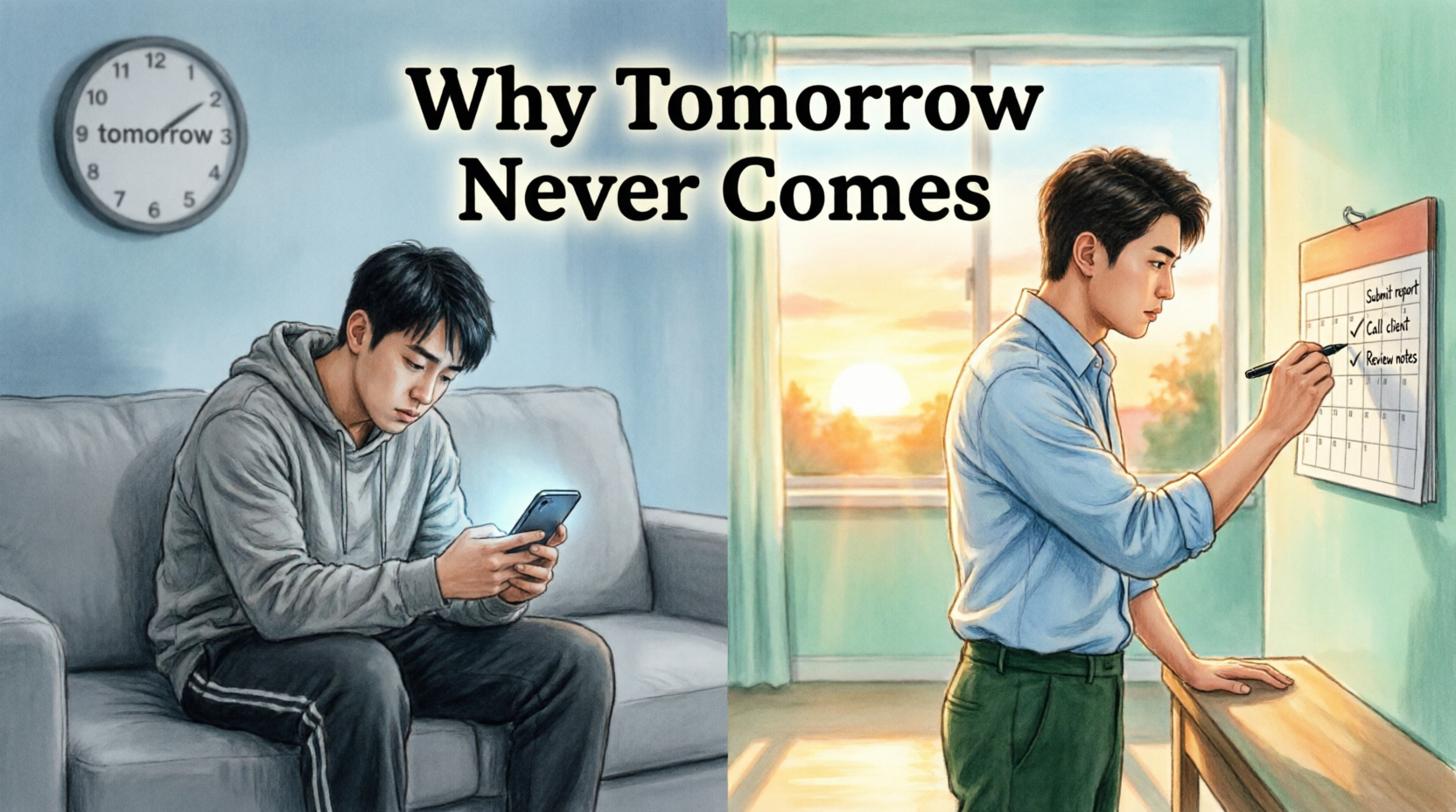
Why You Keep Saying “I’ll Do It Tomorrow” – The Science of Procrastination Explained
Learn why you say “I’ll do it tomorrow,” the 4 procrastination types, their hidden impacts, and a practical 4-step system to build real momentum in just 21 days.
You’ve probably said it a hundred times: “I’ll start the gym tomorrow,” “I’ll finish that project tomorrow,” or “I’ll have that difficult conversation tomorrow.” It feels harmless in the moment, but those tomorrows add up to lost opportunities, mounting stress, and a nagging sense of guilt. This article dives into the real reasons behind procrastination – it’s not about laziness – and gives you a clear, practical way to break the habit using insights from psychology and everyday brain science. You’ll learn the four main types of procrastinators, why it hurts your life, and a simple 4-step system to start taking action today instead of waiting for the perfect moment.
The Surprising Truth: Why Your Brain Loves ‘Tomorrow’ More Than ‘Today’
Procrastination isn’t laziness or a lack of willpower. It’s your brain’s natural way to avoid short-term discomfort or negative emotions. People usually fit into one of four categories: the overthinker who gets paralyzed by too many options, the dopamine guider who prefers instant rewards over long-term goals, the sloth bear who struggles with low energy and motivation, or the companion seeker who needs social accountability to begin. This common habit reduces productivity for many people, increases stress and anxiety, and means only a small percentage of New Year resolutions actually succeed. The key is identifying your own procrastination style so you can tackle it directly. With a straightforward 4-step approach, you can rewire your habits in as little as 21 days and start seeing real change.
The Surprising Truth: Why Your Brain Loves ‘Tomorrow’ More Than ‘Today’
Procrastination isn’t laziness or a lack of willpower.
It’s your brain’s natural way to avoid short-term discomfort or negative emotions.
People usually fit into one of four categories: the overthinker who gets paralyzed by too many options, the dopamine guider who prefers instant rewards over long-term goals, the sloth bear who struggles with low energy and motivation, or the companion seeker who needs social accountability to begin.
This common habit reduces productivity for many people, increases stress and anxiety, and means only a small percentage of New Year resolutions actually succeed.
The key is identifying your own procrastination style so you can tackle it directly.
With a straightforward 4-step approach, you can rewire your habits in as little as 21 days and start seeing real change.
“Procrastination isn’t a time management issue.
It’s an emotion management issue.”
Understanding your type is the first step to breaking free and building momentum that lasts.
Why This Matters in Your Daily Life
Procrastination shows up in small ways that quietly shape your week, month, and year. It can mean unfinished tasks piling up, strained relationships when you delay important conversations, or missed chances to build better health and career growth. When you understand the brain science behind it, you gain the power to protect your time and energy. Small daily wins become possible instead of constant guilt. This knowledge helps students, professionals, and anyone trying to build better routines feel more in control of their days.

Common Misunderstandings About Procrastination
Many believe procrastination is simply poor time management or a sign of laziness. In truth, it is often tied to how your brain handles emotions and discomfort. Here are a few common myths:
- “It’s just laziness” – Most procrastinators are actually busy; they just focus on easier, immediate tasks instead of the important ones.
- “Motivation will come later” – Waiting for motivation rarely works because the brain prefers quick rewards over long-term effort.
- “Everyone does it, so it’s harmless” – While common, ongoing procrastination can quietly raise stress levels and lower overall life satisfaction.
If overthinking is your pattern, you might recognize patterns described in our guide on why smart people overthink. Similarly, if low energy is the issue, habits that silently destroy your brain often play a hidden role.
The Four Types of Procrastinators
Recognizing your personal style makes change much easier.

The Overthinker You spend so much time analyzing every option that you never start. This type often links to perfectionism and can connect to how the nervous system works under pressure.
The Dopamine Guider You chase quick hits of pleasure – scrolling, snacks, or games – instead of the bigger goal. Cold showers and dopamine science offer one natural way to reset this pattern.
The Sloth Bear Low energy or poor sleep makes even simple tasks feel impossible. Simple changes in sleep and energy habits can help here.
The Companion Seeker You wait for a friend or group to get motivated before you begin.
The 3 Chronic Impacts of Procrastination
Left unchecked, procrastination quietly lowers productivity, raises stress and anxiety, and prevents you from reaching goals. Over time it can affect confidence and even physical health through constant low-level worry.
A Practical 4-Step System to Stop Procrastinating
- Identify your main villain (your personal type).
- Confront the discomfort head-on instead of avoiding it.
- Rewrite your inner script with kinder, more realistic self-talk.
- Track small proofs of progress every day for 21 days.
FAQ
Is procrastination genetic? Some personality traits play a role, but habits and environment matter more – and both can be changed with consistent practice.
How long does it take to see results? Many people notice a shift within 21 days when they follow the 4-step system and track daily progress.
Does this only affect students? No – it impacts professionals, parents, and anyone with goals. The types and solutions apply across all ages.
Can I fix it without changing my whole routine? Yes. Start with just one type and one small step. The system is designed to be simple and sustainable.
What if I slip back into old habits? That’s normal. Use your proof tracker to restart without self-judgment – consistency over perfection is the goal.