

By Govind Kumar · Figures checked against SEBI’s Mutual Funds Regulations, 2026 and current capital gains tax rules
Open any fund house app and you will often see two NAVs for one scheme, one slightly higher than the other. Same fund manager, same stocks, same risk. The only thing separating them is who you bought through and how much that route costs you every single year. This Wikipedia Search guide puts the direct vs regular mutual fund debate into actual rupees, explains what SEBI’s new expense rules changed, and shows the one mistake that turns a smart switch into a tax bill.
Direct vs Regular Mutual Fund: Same Fund, Two Price Tags
A direct plan is bought straight from the asset management company (AMC), through its website, a platform like MF Central, or an app that offers direct plans. A regular plan is bought through an intermediary such as a bank relationship manager, broker or mutual fund distributor, who earns a trail commission from the fund house for as long as you stay invested.
| Feature | Direct plan | Regular plan |
| Portfolio and fund manager | Same | Same |
| Risk level | Same | Same |
| Expense ratio | Lower | Higher (includes distributor commission) |
| NAV | Higher over time | Lower over time |
| Who helps you choose | You, or a fee-only adviser | Your distributor |
| Name on statement | “Direct” or “Dir” | “Regular” or “Reg” |
The NAV difference is a result, not a feature. Because the direct plan deducts a smaller fee every day, its NAV slowly pulls ahead of the regular plan’s NAV. That is the entire story of returns here.
What the Gap Looks Like in Actual Rupees
Percentages like “1% extra” sound small. Compounding makes them large. Here is a ₹10,000 monthly SIP at an assumed 12% gross return, with a 0.6% expense ratio for the direct plan and 1.6% for the regular plan (a realistic 1 percentage point gap for an actively managed equity fund):
| SIP duration | Total invested | Direct plan value | Regular plan value | Money lost to the cost gap |
| 10 years | ₹12 lakh | ₹22.4 lakh | ₹21.1 lakh | ₹1.3 lakh |
| 15 years | ₹18 lakh | ₹47.7 lakh | ₹43.4 lakh | ₹4.3 lakh |
| 20 years | ₹24 lakh | ₹92.2 lakh | ₹80.7 lakh | ₹11.5 lakh |
| 25 years | ₹30 lakh | ₹1.71 crore | ₹1.43 crore | ₹27.3 lakh |
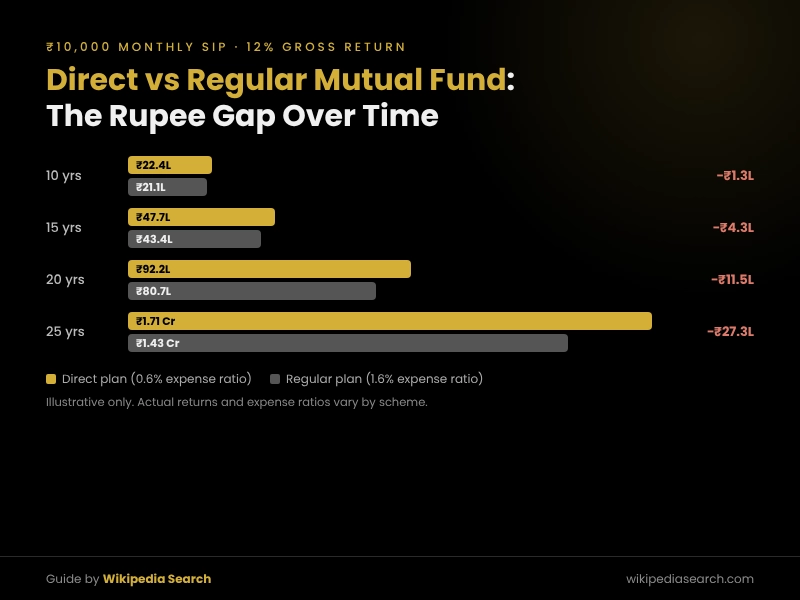
Notice the pattern. In the first decade the gap looks like a rounding error. By year 25, the cost difference is close to what you invested in total. That is why time horizon matters more than the headline percentage.
Important: these are illustrations, not promised returns. Actual gaps vary by scheme. Index funds and debt funds usually have a much smaller difference between direct and regular plans, sometimes 0.2% to 0.5%, so the rupee gap shrinks too. Always compare the two expense ratio figures for your exact scheme on the AMC’s website or the AMFI website.
What SEBI’s New Expense Rules Changed (and What They Did Not)
SEBI replaced its 1996 mutual fund rulebook with the SEBI (Mutual Funds) Regulations, 2026, which took effect from 1 April 2026. Three changes matter for this comparison:
- Base Expense Ratio (BER): the old single TER is now split. The BER covers the AMC’s fee and running costs, and in a regular plan it also carries the distribution commission. Brokerage and statutory levies such as GST are shown separately.
- Lower caps: maximum BER limits came down by roughly 10 to 15 basis points depending on scheme size.
- Clearer disclosure: you can now see what you pay for fund management separately from taxes and trading costs.
What did not change: the regular plan still pays the distributor out of your returns, so the direct plan remains cheaper. Analysts quoted in Outlook Money pointed out that the new structure brings cleaner disclosure rather than big savings for investors. The practical benefit for you is easier comparison: put the BER of the direct and regular plan side by side, and the difference is roughly the commission.
4 Myths That Keep People in the Wrong Plan
Myth 1: “Direct plans are riskier.” Risk depends on what the fund owns, not on how you bought it. A direct small cap fund and a regular small cap fund carry exactly the same risk.
Myth 2: “A higher NAV means the direct plan is expensive.” NAV is not a price tag. You get fewer units at a higher NAV, but those units grow at the same rate as the portfolio minus a smaller fee. A higher NAV in the direct plan is a sign of lower costs, not a reason to avoid it.
Myth 3: “My regular plan comes with free advice.” It is not free. You pay for it every year through the expense ratio. If your distributor reviews your goals, rebalances your portfolio and stops you from panic-selling in a crash, that service may be worth it. If you only hear from them when there is a new fund to buy, you are paying for advice you are not getting.
Myth 4: “Direct means I must do everything alone.” Not necessarily. A SEBI-registered investment adviser (RIA) charges you a fixed or percentage fee directly and recommends direct plans. You get advice without commission conflicts. You can verify an adviser’s registration on the SEBI website.
Direct vs Regular Mutual Fund: Which One Fits You?

| If this sounds like you… | Better fit | Why |
| You can pick 2 to 4 funds, review them once a year and stay calm in falls | Direct plan | You keep the full cost saving |
| You are investing for 10 years or more | Direct plan | The gap compounds the longest |
| You want advice but no commission conflict | Direct plan + fee-only RIA | You pay a visible fee, not a hidden one |
| You are a first-time investor who would otherwise not invest at all | Regular plan (for now) | Starting matters more than the cheapest route |
| Your distributor actively plans goals, rebalances and holds your hand in crashes | Regular plan | You are getting value for the commission |
| An elderly parent needs someone to handle paperwork and nominations | Regular plan or a family member managing direct | Service matters more than a small fee |
A useful test: write down what your distributor did for you in the last 12 months. If the list is short, the commission is not earning its keep.
Switching From Regular to Direct: Avoid the Tax Trap
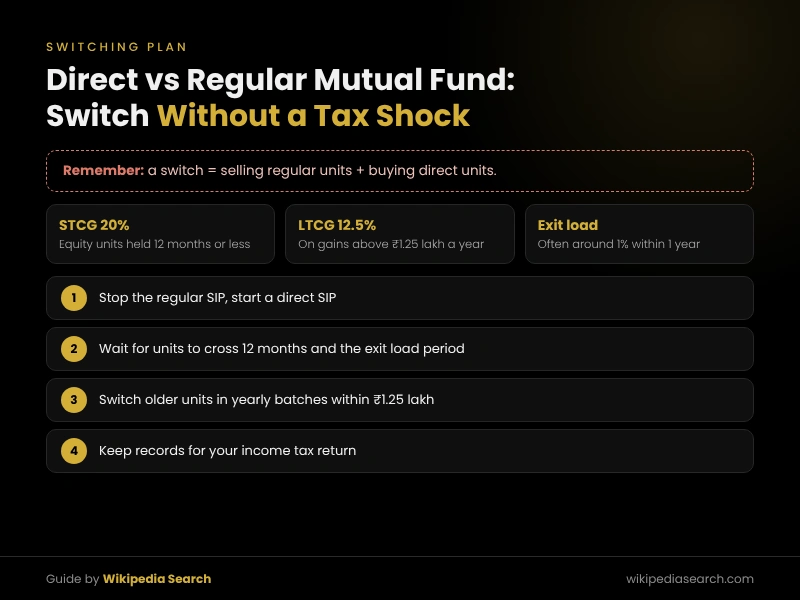
This is the part most comparison articles get wrong. Several guides describe moving from regular to direct as a simple switch. In practice, the switch from regular to direct plan is treated as selling your regular units and buying direct units. That means two possible costs:
1. Capital gains tax. For equity mutual funds under current rules:
| Holding period of the units you switch | Tax on gains |
| 12 months or less | Short-term capital gains (STCG) taxed at 20% |
| More than 12 months | Long-term capital gains (LTCG) taxed at 12.5% on gains above ₹1.25 lakh in a financial year |
Debt fund gains on units bought after 1 April 2023 are added to your income and taxed at your slab rate, whatever the holding period.
2. Exit load. Many equity funds charge around 1% if units are redeemed within a year. A switch counts as redemption.
3. ELSS lock-in. Tax-saving ELSS units cannot be switched until their 3-year lock-in ends.
A Smarter Way to Move
- Stop the regular SIP and start a new SIP in the direct plan of the same or a better fund. New money goes into the cheaper plan immediately, with zero tax.
- Leave recent units alone until they cross 12 months and the exit load period.
- Switch older units in batches each financial year, keeping long-term gains within the ₹1.25 lakh tax-free limit where possible.
- Keep a record of each switch for your income tax return.
Example: Priya has ₹4 lakh in a regular flexi cap fund with ₹1.8 lakh of long-term gains. Switching everything in one year means ₹55,000 of gains above the limit, taxed at 12.5%, or about ₹6,900. Splitting the switch across two financial years could keep both halves near the tax-free limit and bring the tax close to zero.
How to Check Whether You Hold Direct or Regular Plans
- Look at the scheme name on your statement or app. It will say “Direct” or “Regular” (sometimes “Dir” or “Reg”).
- Download your Consolidated Account Statement (CAS) for free from MF Central, CAMS or KFintech using your PAN and registered email.
- Check the broker or ARN column. A regular plan shows the distributor’s ARN code. A direct plan shows “Direct.”
Many people discover that a bank or app quietly put them into regular plans. Five minutes with your CAS will tell you exactly where you stand.
FAQs
Is direct mutual fund better than regular for beginners?
Direct is cheaper, but a beginner who feels unsure might invest more consistently with guidance. A good middle path is a direct plan in a simple index or flexi cap fund, or direct plans chosen with help from a fee-only SEBI-registered adviser.
Do direct and regular plans have the same portfolio?
Yes. Both plans of a scheme hold the same stocks or bonds, are run by the same fund manager and carry the same risk. Only the expense ratio, and therefore the NAV and returns, differ.
How much higher is the return in a direct mutual fund?
Roughly equal to the expense ratio gap, often 0.5% to 1% a year for active equity funds and less for index and debt funds. Over 20 years, that can add up to several lakh rupees on a regular SIP.
Can I switch from regular to direct without paying tax?
Not fully. A switch counts as redemption, so capital gains tax and any exit load apply. You can reduce tax by stopping new regular SIPs, waiting for units to turn long term, and spreading switches across financial years.
Direct aur regular mutual fund mein kya fark hai?
Dono mein fund aur portfolio bilkul same hota hai. Fark sirf kharche ka hai: regular plan mein distributor ka commission juda hota hai, isliye uska expense ratio zyada hota hai aur lambe samay mein return kam ho jaata hai.
Kya regular se direct plan mein switch karna chahiye?
Agar aap khud fund chun sakte hain toh haan, lekin soch samajh kar. Pehle naya SIP direct plan mein shuru kariye, aur purane units ko 12 mahine poore hone ke baad thoda thoda switch kariye taaki tax aur exit load kam lage.
Make Your Next SIP the Cheaper One
You now know that direct and regular plans hold the same fund, how much the cost gap can grow over time, and how to move without a surprise tax bill. Download your CAS today, check which plans you hold, and make sure your next rupee goes into the version that fits how you actually invest.
For more plain-language guides on money, banking and everyday finance, explore Wikipedia Search. If a friend or family member invests through their bank, share this page so they can check their plan too.
What’s New in This Update
Latest update:
- Added a rupee-by-rupee SIP cost table for 10, 15, 20 and 25 years
- Explained how SEBI’s Mutual Funds Regulations, 2026 and the new Base Expense Ratio affect this comparison
- Added a tax-smart switching plan using current STCG, LTCG and exit load rules
We review this guide regularly and update it whenever SEBI rules, tax rates or expense structures change.
Disclaimer
Wikipedia Search is an independent information website and is not a SEBI-registered investment adviser or mutual fund distributor. This article is for education only and is not investment, tax or financial advice. Mutual fund investments are subject to market risks; read all scheme-related documents carefully. Return figures are illustrative and not guaranteed. Tax rules can change, so consult a qualified tax professional or SEBI-registered adviser before making investment decisions.
About the Author
Govind Kumar writes personal finance explainers for Wikipedia Search. He works from SEBI and AMFI documents, scheme disclosures and current tax rules, and turns them into practical numbers that everyday investors can act