

By Govind Kumar · Rates checked against VA’s current published GI Bill, Montgomery GI Bill and DEA rate tables
Two veterans can sit in the same classroom, use the same GI Bill and walk away with paychecks that differ by more than $8,000 a year. The difference is rarely luck. It comes down to which program they chose, how they enrolled and a few rules that never make it onto a recruiting brochure. This Wikipedia Search guide breaks down VA education benefits in real dollars, so you can see which option pays you the most before you sign up for a single class.
The Main VA Education Benefits at a Glance

| Program | Who it’s for | What it pays |
| Post-9/11 GI Bill (Chapter 33) | Veterans and service members with at least 90 days of active duty after September 10, 2001 | Tuition and fees, books stipend and monthly housing allowance, scaled by your eligibility tier |
| Montgomery GI Bill Active Duty (Chapter 30) | Those who paid $1,200 into the MGIB during service | Flat monthly payment straight to you ($2,601 for full-time college at the 3-year rate) |
| Montgomery GI Bill Selected Reserve (Chapter 1606) | Guard and Reserve members with a 6-year obligation | Smaller monthly payment while you serve |
| Veteran Readiness and Employment (Chapter 31) | Veterans with a service-connected disability that affects employment | Training, tuition, supplies and a subsistence allowance, based on an approved career plan |
| Survivors’ and Dependents’ Educational Assistance (DEA, Chapter 35) | Spouses and children of certain disabled, deceased or missing service members | $1,621 a month for full-time study |
| Fry Scholarship | Children and spouses of service members who died in the line of duty after September 10, 2001 | Post-9/11 GI Bill benefits at the 100% level |
| VET TEC 2.0 | Veterans with 36+ months of active duty pursuing tech training | Covers approved high-tech training plus a housing allowance |
Most veterans will compare the first two. That comparison is where the real money decisions happen.
How the Post-9/11 GI Bill Really Pays You
The Post-9/11 GI Bill has three money streams, and each one is scaled by your eligibility percentage.
1. Tuition and fees. At public schools, VA pays the full in-state tuition and mandatory fees. At private and foreign schools, VA pays up to $30,908.34 a year at the 100% tier. Schools in the Yellow Ribbon Program can cover part of the gap above that cap, and VA matches what the school contributes.
2. Books and supplies. Up to $1,000 a year, paid at about $41.67 per credit hour for up to 24 credits.
3. Monthly housing allowance (MHA). Based on the military Basic Allowance for Housing (BAH) for an E-5 with dependents in your school’s ZIP code. You must be enrolled at more than half time to get it. Fully online students get a fixed amount instead, currently up to $1,261 a month.
Your Eligibility Tier
| Active duty served after September 10, 2001 | Percentage of benefits |
| 36 months or more (1,095+ days) | 100% |
| 30 to 35 months | 90% |
| 24 to 29 months | 80% |
| 18 to 23 months | 70% |
| 6 to 17 months | 60% |
| 90 days to 5 months | 50% |
Purple Heart recipients and veterans discharged for a service-connected disability after at least 30 days of service qualify at 100% regardless of time served.
Three Real-Dollar Scenarios
Rules make more sense with numbers. These examples use current VA rates and an illustrative housing rate of $2,200 a month for the school’s ZIP code.
Scenario 1: The Online-Only Trap

Consider a veteran at the 100% tier taking a full course load for a 9-month school year.
| Enrollment choice | Monthly housing allowance | 9-month total |
| All classes online | $1,261 | $11,349 |
| At least one class in person, rest online | $2,200 | $19,800 |
| Difference | $8,451 |
That gap exists because VA pays the full local housing rate if even one class counts as in-person or hybrid. Switching a single course can be worth thousands. Confirm with your school certifying official that the class is coded correctly before you register.
Scenario 2: The Private School Gap at a Lower Tier
A veteran at the 60% tier enrolls at a private university charging $45,000 a year.
- VA pays 60% of the $30,908.34 cap, about $18,545
- The remaining $26,455 is the veteran’s responsibility
- Yellow Ribbon generally does not help, because it usually requires the 100% tier
Before committing to an expensive private school, check your tier on your Certificate of Eligibility and compare schools with VA’s GI Bill Comparison Tool.
Scenario 3: When the Montgomery GI Bill Pays More
A veteran with both benefits attends a community college charging $4,000 a year, in a rural area where the housing rate is about $1,700 a month.
| Option | What reaches the student | Approximate 9-month value |
| Montgomery GI Bill | $2,601 a month in cash; student pays $4,000 tuition | About $19,400 left after tuition |
| Post-9/11 GI Bill | Tuition paid, $1,700 a month MHA, $1,000 books | About $16,300 in hand |
In low-cost areas with cheap tuition, the Montgomery GI Bill can put more money in your pocket. In high-cost cities or at expensive schools, the Post-9/11 GI Bill almost always wins. Run your own numbers before choosing.
The Rudisill Rule: You May Have 48 Months, Not 36
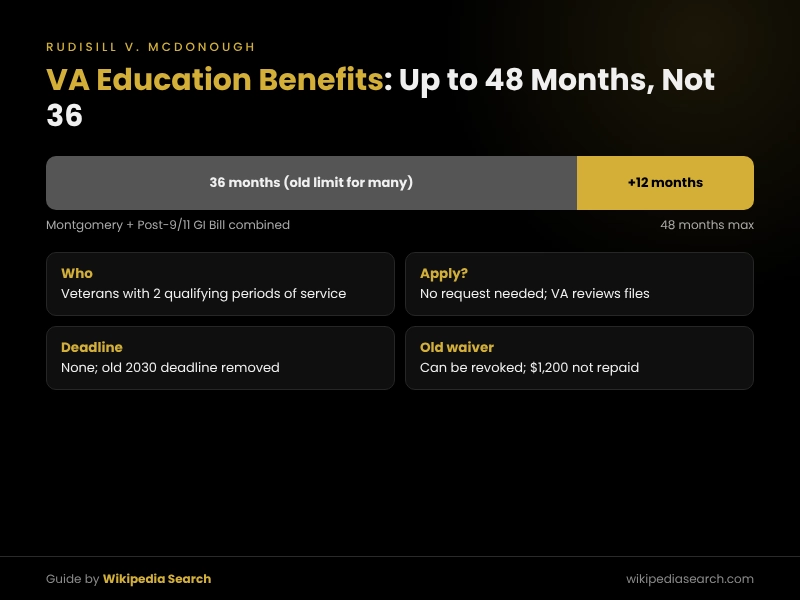
For years, veterans who had both the Montgomery GI Bill and the Post-9/11 GI Bill were told they had to give up one, and many were capped at 36 total months. In April 2024, the U.S. Supreme Court ruled in Rudisill v. McDonough that veterans with two separate qualifying periods of service can use both benefits, up to a combined 48 months of entitlement.
What that means for you now:
- No application needed. VA says it is reviewing files automatically and will notify veterans if action is required.
- No deadline. VA has removed the earlier 2030 deadline for these claims.
- Waivers can be revoked. If you previously gave up the MGIB to use Post-9/11 benefits, that waiver can be undone, and you don’t need to repay the $1,200 contribution.
- One period of service may count too. A later court ruling, Perkins v. Collins, found that some veterans with a single long enough period of service may also qualify for both programs. VA says it will review affected files.
You still cannot use both programs at the same time. If you think you qualify, check your remaining entitlement on VA.gov or call the GI Bill hotline before you plan your final semesters. The details are on VA’s Rudisill information page.
VET TEC 2.0: Tech Training Without Burning Your GI Bill
VET TEC 2.0 is VA’s revived high-tech training program. It covers approved programs in fields like software development, data and cybersecurity, and pays a housing allowance while you train.
Key points from VA:
- You need at least 36 months of active duty, a discharge other than dishonorable (or be within 180 days of separating), and be under age 62 when approved.
- If you still have GI Bill or DEA entitlement, VA charges one month for each month of full-time training. If you have no entitlement left, you can still qualify.
- You can use VET TEC 2.0 benefits only once, and seats are limited, so choose an approved provider carefully.
Details and the application are on VA’s VET TEC 2.0 page.
Other Benefits Most Veterans Overlook
Edith Nourse Rogers STEM Scholarship. If you are running low on Post-9/11 entitlement while finishing a STEM degree or teaching certification, this scholarship can add up to 9 months of benefits, capped at $30,000.
Licensing and certification tests. VA reimburses test fees, up to $2,000 per test under the Post-9/11 GI Bill, for licenses like real estate, commercial driving or IT certifications. Entitlement is charged in proportion to the cost, not by the month.
Rural relocation grant. A one-time $500 payment if you live in a county with 6 or fewer people per square mile and must move at least 500 miles to attend school.
Transfer to family (GI Bill transferability). Service members with at least 6 years of service who agree to serve 4 more can transfer Post-9/11 benefits to a spouse or children. The request must be approved while you are still serving.
No expiration for many veterans. Under the Forever GI Bill, Post-9/11 benefits never expire if your service ended on or after January 1, 2013. Earlier separations generally have a 15-year limit.
7 Costly Mistakes to Avoid
- Taking every class online when one in-person course would raise your housing allowance.
- Dropping below more than half-time, which stops your housing allowance entirely.
- Choosing a private school without checking your tier and whether Yellow Ribbon applies.
- Skipping monthly enrollment verification. VA pays housing and other payments only after you confirm enrollment.
- Assuming you only have 36 months. The Rudisill decision may give you up to 48.
- Using GI Bill months on cheap courses you could pay for with tuition assistance, scholarships or Pell Grants, saving entitlement for costlier terms.
- Not filing the FAFSA. GI Bill benefits generally do not reduce federal student aid eligibility, and grants can cover costs the VA doesn’t.
How to Apply for VA Education Benefits
- Check eligibility on VA.gov/education.
- Compare schools with the GI Bill Comparison Tool, including housing rates and Yellow Ribbon participation.
- Apply online. Most veterans use VA Form 22-1990. Dependents and Fry Scholarship applicants use the form VA lists for their program.
- Get your Certificate of Eligibility (COE) and give it to your school’s certifying official.
- Register for classes and verify enrollment monthly so payments keep arriving.
Questions about your claim can go to the VA education call center at 888-442-4551.
FAQs
Do VA education benefits expire?
It depends on the program and when you separated. Post-9/11 GI Bill benefits do not expire if your service ended on or after January 1, 2013. The Montgomery GI Bill generally must be used within 10 years of leaving service.
Can I use the GI Bill for online classes?
Yes. Tuition is covered the same way, but fully online students receive a lower, fixed housing allowance. Taking at least one in-person or hybrid class usually qualifies you for the full local rate.
Can I use VA education benefits and FAFSA together?
Yes. GI Bill payments are generally not counted against federal student aid, so filing the FAFSA can unlock Pell Grants and other aid that stack with your VA benefits.
How many months of GI Bill benefits do I get?
Most programs provide 36 months of full-time entitlement. Veterans who qualify for both the Montgomery and Post-9/11 GI Bills may be able to use up to 48 months combined under the Rudisill decision.
Can my spouse or children use my VA education benefits?
Yes, through a transfer of Post-9/11 benefits approved while you are serving, or through programs like DEA and the Fry Scholarship if your family qualifies based on your service-connected disability or death.
Make Every Month of Your GI Bill Count
You now know how each program pays, why one in-person class can be worth thousands, when the Montgomery GI Bill beats the Post-9/11 GI Bill, and how the Rudisill decision may give you extra months. Check your Certificate of Eligibility, run your own numbers in the comparison tool, and talk to your school certifying official before you register.
For more clear, practical guides on education and money decisions, explore Wikipedia Search. If you know a veteran who is heading back to school, share this page with them before they enroll.
What’s New in This Update
Latest update:
- Updated Post-9/11 GI Bill, Montgomery GI Bill and DEA figures to VA’s current published rates
- Added three real-dollar scenarios, including the online-only housing allowance gap
- Added Rudisill and Perkins guidance and the relaunched VET TEC 2.0 program
We review this guide regularly and update it whenever VA publishes new rates or rule changes.
Disclaimer
Wikipedia Search is an independent information website and is not affiliated with or endorsed by the U.S. Department of Veterans Affairs or any branch of the military. Benefit rates, eligibility rules and program availability change, and your exact benefits depend on your service history. Always confirm your eligibility and payments with VA or your school certifying official before making enrollment decisions.
About the Author
Govind Kumar writes education and money guides for Wikipedia Search. He works directly from VA rate tables, federal program pages and court rulings to turn complicated benefit rules into clear, dollar-based decisions readers can act on.