

By Govind Kumar · Lifespan ranges compared across independent testers, retailers and published sleep research
Your mattress does not come with an expiration date stamped on the tag, and it rarely fails all at once. It loses support a little at a time, so slowly that most people adjust their sleep around it without noticing. That is exactly why “how long do mattresses last” is such a common question, and why the honest answer is “it depends on you.” This Wikipedia Search guide gives you the typical lifespan for every mattress type, a simple way to estimate how long yours should last, and the checks that tell you when it is truly done.
How Long Do Mattresses Last by Type?
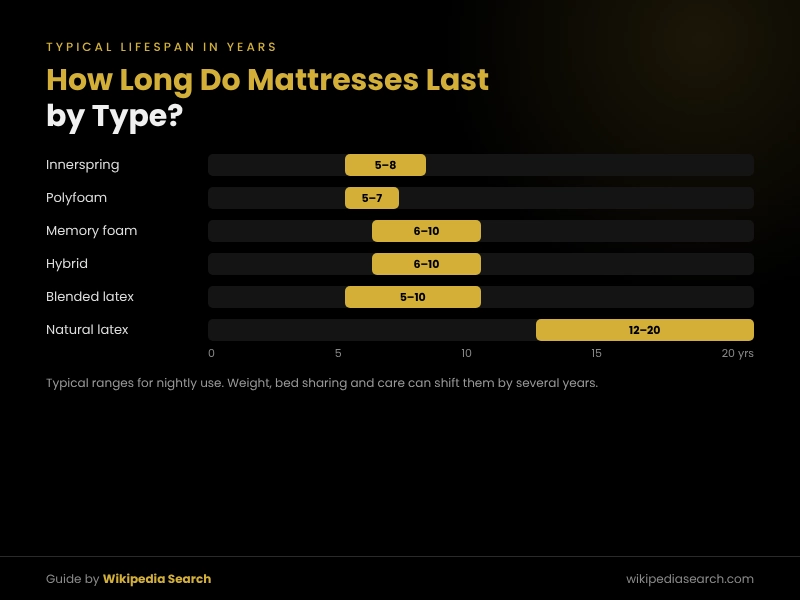
Different guides quote slightly different numbers, because there is no long-term independent study that tracks thousands of mattresses to the end of their life. The ranges below reflect where testers, retailers and manufacturers broadly agree.
| Mattress type | Typical lifespan | Why it wears out |
| Innerspring | 5 to 8 years | Coils lose tension and the thin comfort layer compresses |
| Polyfoam (budget all-foam) | 5 to 7 years | Low-density foam softens and develops body impressions |
| Memory foam | 6 to 10 years | Foam slowly loses its ability to bounce back, depending on density |
| Hybrid | 6 to 10 years | Durable coils, but the foam comfort layers wear first |
| Blended or synthetic latex | 5 to 10 years | Fillers reduce durability compared with pure latex |
| Natural latex | 12 to 20 years | Dense, resilient material that resists sagging |
One pattern to notice: the comfort layers on top almost always wear out before the support core underneath. A hybrid with excellent coils can still feel “done” at year 7 if its top foam has softened. When shopping, ask about foam density, not just coil count.
Estimate How Long Your Own Mattress Should Last
A 6 to 10 year range is not very useful if you are trying to decide whether your 7-year-old mattress is worn out. Use this quick estimate instead. Start with the middle of the range for your mattress type, then adjust.
Subtract years if:
| Factor | Adjustment |
| Two adults share the bed every night | Minus 1 year |
| Either sleeper weighs over about 250 pounds | Minus 1 to 2 years |
| Kids or pets regularly jump or sleep on it | Minus 1 year |
| Foam layers are low-density (under about 1.8 pounds per cubic foot) | Minus 1 to 2 years |
| No mattress protector, frequent spills or sweat | Minus 1 year |
| Wrong or sagging base (old box spring, wide slat gaps) | Minus 1 to 2 years |
Add years if:
| Factor | Adjustment |
| Used only as a guest bed | Plus 3 to 5 years |
| Rotated every 3 to 6 months as the brand recommends | Plus 1 year |
| Waterproof protector used from day one | Plus 1 year |
| Single, lighter-weight sleeper | Plus 1 year |
Example: A couple sleeps on a memory foam mattress (middle estimate: 8 years). Two adults sharing every night takes off 1 year, and their two dogs on the bed take off another. They used a protector from the start, which adds 1 back. Their realistic lifespan is about 7 years, not the 10 years printed on the marketing page.
This is a rule of thumb, not a lab measurement. It helps you know when to start paying closer attention.
7 Signs Your Mattress Is Done (Whatever Its Age)
Age is only a clue. These signs matter more:
- Visible sag or body impressions. A dip of about 1.5 to 2 inches where you sleep usually means the support is gone.
- You wake up stiff or sore, and it eases within 30 minutes of getting up.
- You sleep better elsewhere, like a hotel or a friend’s guest room.
- You roll toward the middle or toward your partner during the night.
- Coils squeak, poke or can be felt through the comfort layer.
- Allergy symptoms are worse in bed, especially in the morning. Old mattresses collect dust mites, skin cells and moisture.
- The edges collapse when you sit on the side of the bed.
If two or more of these apply, your mattress is likely past its useful life, even if it is younger than the typical range.
The 5-Minute Mattress Check
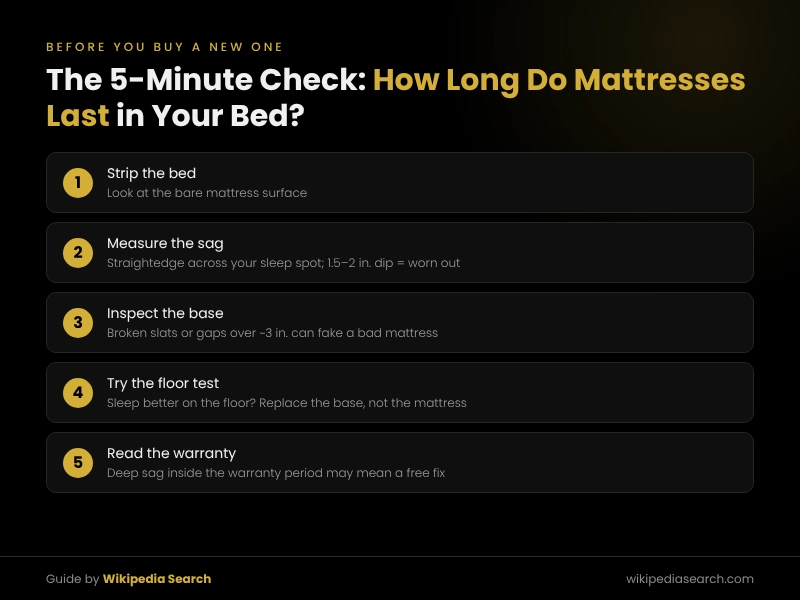
Before you spend money, run this quick test to confirm the problem is really the mattress.
- Strip the bed down to the bare mattress.
- Lay a broom handle or yardstick across the mattress where you sleep. Measure the gap between the stick and the surface with a ruler.
- Check the base. Look for broken slats, a sagging box spring or slats more than about 3 inches apart. A bad foundation can make a good mattress feel worn out.
- Try the floor test. If you’re unsure, put the mattress on the floor for a night or two. If you sleep noticeably better, the base, not the mattress, is the problem.
- Read your warranty. If the sag is deep enough and the mattress is within the warranty period, you may be able to get a repair or replacement.
Warranty Length Is Not Lifespan
A 10-year or “lifetime” warranty does not mean the mattress will feel comfortable for that long. Here is what most mattress warranties actually cover:
- Manufacturing defects, such as split seams, broken coils or foam that cracks.
- Body impressions deeper than a set limit, often somewhere between about 0.75 and 1.5 inches, depending on the brand.
- Not comfort changes. If the mattress simply feels softer than it used to, that is usually treated as normal wear.
Many warranties are also prorated after the first several years, meaning you pay part of the replacement cost. Stains or using the wrong base can void coverage entirely, which is one more reason to use a protector and follow the brand’s foundation rules.
Topper, Repair or Replace?
| Your situation | Best move |
| Mattress feels too firm but is supportive | Add a 2 to 3 inch mattress topper |
| Mattress is under 5 years old with slight softness | Rotate it and add a topper |
| Visible sag of 1.5 inches or more | Replace (a topper will sink into the dip) |
| Sag within warranty limits and period | File a warranty claim before buying new |
| Broken coils or torn foam | Replace |
| Problem disappears on the floor | Replace the base, not the mattress |
A topper changes how a bed feels. It cannot restore support that has broken down underneath.
What a Mattress Really Costs Per Night
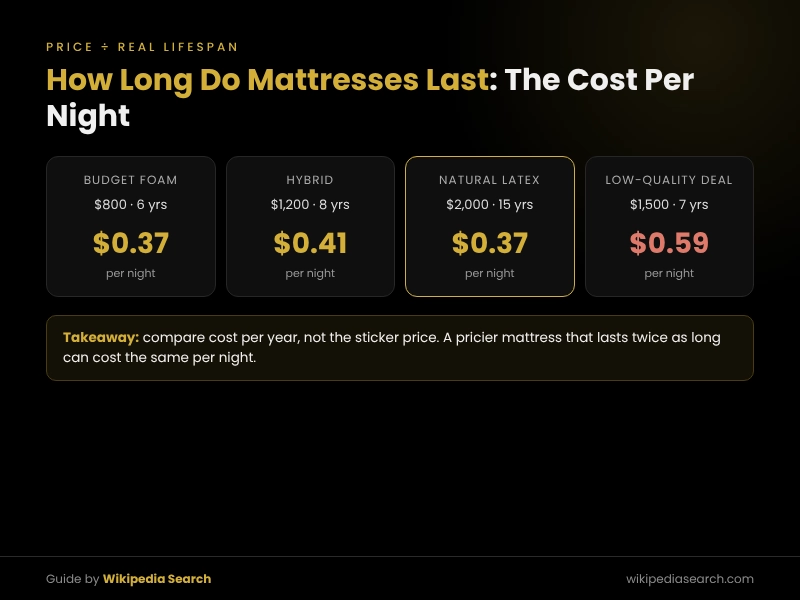
A cheaper mattress is not always cheaper over time. Divide the price by how long it actually lasts:
| Mattress | Price | Realistic lifespan | Cost per year | Cost per night |
| Budget foam | $800 | 6 years | $133 | About $0.37 |
| Mid-range hybrid | $1,200 | 8 years | $150 | About $0.41 |
| Natural latex | $2,000 | 15 years | $133 | About $0.37 |
| Low-quality “deal” mattress | $1,500 | 7 years | $214 | About $0.59 |
A natural latex mattress can cost the same per night as a budget foam bed, simply because it lasts more than twice as long. When you compare prices, compare cost per year, not just the sticker.
Why Replacing an Old Mattress Can Pay Off
Sleep researchers at Oklahoma State University studied 59 healthy adults whose beds averaged about 9.5 years old. After four weeks on their own beds, participants switched to new medium-firm bedding for four weeks. According to the study published in the Journal of Chiropractic Medicine, back pain dropped by about 48%, sleep quality improved by more than half, and reported stress symptoms fell by about 20%.
It was a small study, and individual results vary. Still, it supports what many people notice in practice: a worn-out mattress quietly costs you sleep.
How to Make Your Mattress Last Longer
- Use a breathable, waterproof protector from the first night.
- Rotate the mattress 180 degrees every 3 to 6 months, unless the brand says otherwise. Only flip it if it is designed to be two-sided.
- Match the base to the mattress. Many foam and hybrid brands require solid support or slats no more than about 3 inches apart.
- Vacuum the surface every time you change your sheets, and let it air out occasionally.
- Keep kids from jumping and avoid sitting on the same edge every day.
Getting Rid of an Old Mattress
Americans discard more than 50,000 mattresses a day, according to Waste360, and fewer than 10% are recycled, even though most of a mattress can be reused. Your options:
- State recycling programs: California, Connecticut, Rhode Island and Oregon run free drop-off programs through the Mattress Recycling Council’s Bye Bye Mattress program, funded by a small fee collected at purchase.
- Retailer haul-away: Many stores remove your old mattress at delivery, sometimes for a fee.
- Local recycling or bulk pickup: Check your city’s waste department. Massachusetts, for example, bans mattresses from regular trash disposal.
- Donation: Only if the mattress is clean, intact and free of bedbugs. Many charities no longer accept used mattresses, so call first.
FAQs
Can a mattress last 20 years?
Only in rare cases. A high-quality natural latex mattress, or a mattress used occasionally in a guest room, may last close to 20 years. Most mattresses used nightly lose meaningful support well before that.
How long do mattresses last for heavier people?
Expect a shorter lifespan, often 1 to 2 years less than average, for sleepers over about 250 pounds. Choosing high-density foam, natural latex or a hybrid with thicker coils helps it last longer.
Does a mattress topper make a mattress last longer?
A topper can protect the top layers and delay wear on a newer mattress. It cannot fix sagging or broken support, so it will not save a mattress that is already worn out.
Should I replace my mattress every 8 years?
Not automatically. Use 8 years as a reminder to check for sagging, aches and sleep quality. A well-built, well-kept mattress may have years left, while a cheap one may need replacing sooner.
How long does a kid’s mattress last?
Usually 5 to 8 years, but children often need a new bed sooner because they outgrow the size or need firmer support as they grow. Crib mattresses should always be firm and in good condition for safety.
Know When It’s Time, Then Buy Smarter
You now know the realistic lifespan for each mattress type, how to estimate your own, the signs that matter more than age, and why cost per night beats sticker price. Run the 5-minute check tonight. If your mattress passes, add a protector and a rotation reminder. If it fails, you can shop with clear priorities instead of guesswork.
For more practical guides on health, home and everyday decisions, explore Wikipedia Search. If someone in your home keeps waking up sore, share this page with them.
What’s New in This Update
Latest update:
- Added a personal lifespan estimator based on weight, bed sharing, pets, foam density and care
- Added a cost-per-night comparison across mattress types and price points
- Added current U.S. mattress recycling options, including Oregon’s program
We review this guide regularly and update it as new research, materials and recycling programs become available.
Disclaimer
Wikipedia Search is an independent information website and is not affiliated with any mattress brand, retailer or recycling organization. Lifespan figures are typical ranges, not guarantees. If you have ongoing back pain, joint pain or sleep problems, talk to a doctor or qualified health professional, because a mattress may not be the only cause.
About the Author
Govind Kumar writes practical home and health guides for Wikipedia Search. He compares independent testing, manufacturer data and published research to help readers make confident, budget-smart decisions about the products they use every day.