

By Govind Kumar · Every claim rechecked against the original incident report and official aviation and passenger-rights sources at our latest review
Search for UA770 and you’ll find it landed in London, in Chicago, and at an unnamed “nearby airport,” depending on which site you open. Some pages say it happened in May, others in July or August. A few even name a cause that no airline or regulator ever announced. If you’re trying to understand the United Airlines flight UA770 emergency diversion, that mess is frustrating. This Wikipedia Search fact-check separates what’s confirmed from what’s been copied and guessed, then explains what a diversion like this means for you as a passenger.
United Airlines Flight UA770 Emergency Diversion: The Verified Facts
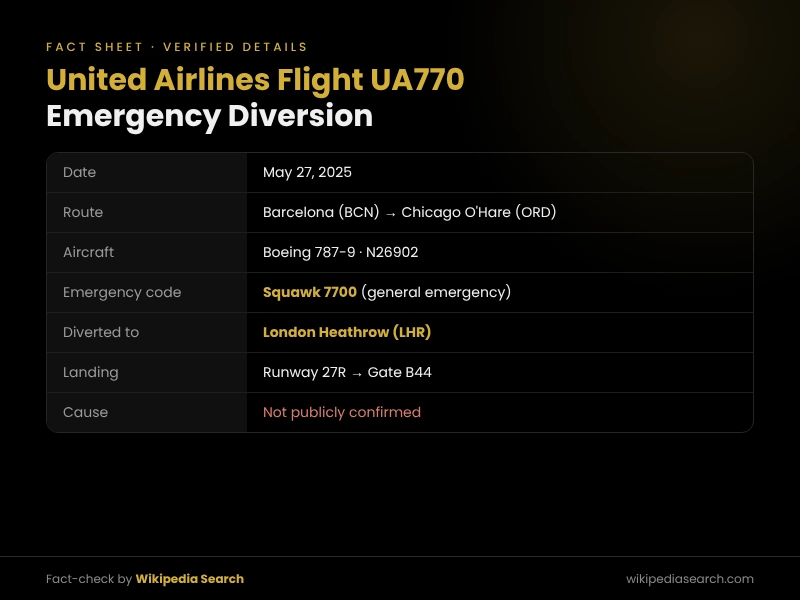
These details come from aviation news site AirLive, which reported the event as it happened and received confirmation from United that the flight was diverting to London.
| Detail | What’s confirmed |
| Date | May 27, 2025 |
| Flight | United Airlines UA770 |
| Route | Barcelona El Prat (BCN) to Chicago O’Hare (ORD) |
| Aircraft | Boeing 787-9 Dreamliner, registration N26902 |
| Emergency code | Squawk 7700 (general emergency) |
| Diverted to | London Heathrow (LHR) |
| Expected landing | About 4:55 PM British Summer Time |
| Landing details | Runway 27R, then gate B44 |
| Next step | United planned a stopover of about one hour |
| Cause | Not publicly confirmed |
| Injuries | None reported in the available coverage |
That last row matters. Anything you read about the cause, the number of passengers or what people felt on board goes beyond what has been verified.
How the Diversion Unfolded, Step by Step
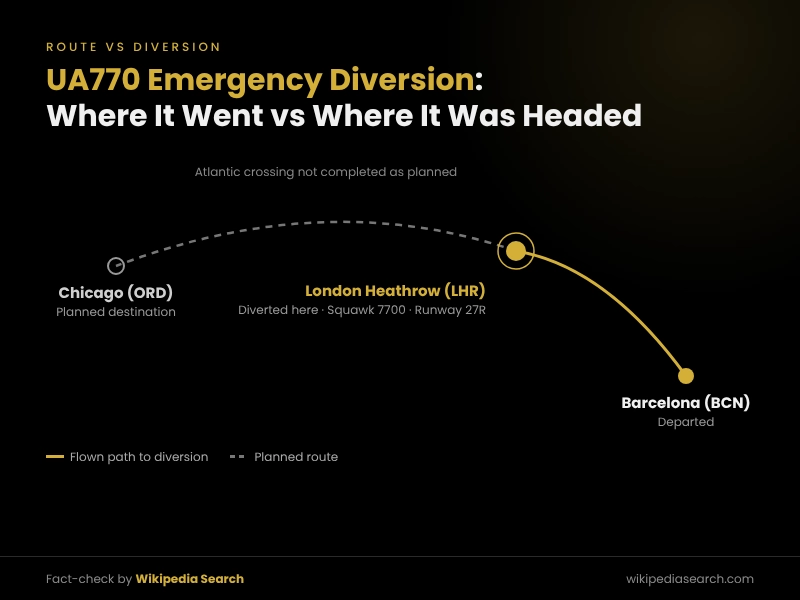
Here is the sequence that can be backed up with a source. Where an exact time isn’t known, it’s left out instead of guessed.
- Departure from Barcelona. UA770 left Barcelona on its regular transatlantic run to Chicago.
- Emergency declared over Europe. The pilots set their transponder to 7700, alerting air traffic control to an emergency and getting priority handling.
- Decision to divert. Instead of continuing across the Atlantic, the crew headed for London Heathrow. United confirmed the diversion to AirLive.
- Landing at Heathrow. The 787 landed on runway 27R, with arrival expected around 4:55 PM local time.
- Taxi to the gate. The aircraft parked at gate B44.
- Short planned stop. United said it was planning a stopover of about one hour at that point.
What’s missing from the public record is just as important: the reason for the emergency, exactly where over Europe it was declared, and how the rest of the journey to Chicago played out.
Heathrow or Chicago? Why the Internet Got UA770 Wrong
If you’ve seen conflicting versions of this story, you’re not imagining it. Here’s how some of the pages ranking for this incident describe it:
| What different pages claim | What the original report shows |
| The flight was “diverted to Chicago” | Chicago was the destination. The diversion was to London Heathrow |
| It happened in July or August 2025 | The incident took place on May 27, 2025 |
| It landed at “a nearby airport” | It landed at a named airport, Heathrow |
| A “system irregularity” or “pressurization anomaly” caused it | No cause has been officially confirmed |
| An aviation “expert” explained what went wrong | No verifiable expert analysis of this flight has been published |
Why does this happen? Breaking aviation stories draw search traffic, so many sites publish quick, template-style articles. Some copy each other, some are written months later but still say “today,” and some fill gaps with guesses. One widely shared version even uses an image labeled as AI-generated while crediting it to the airline.
The Chicago mix-up is the easiest to explain. A headline like “United flight to Chicago declares emergency” gets rewritten as “flight diverted to Chicago,” and the error spreads from there.
What Caused the Emergency? What We Know and What We Don’t
What we know: the crew declared an emergency and chose to land at Heathrow, and the aircraft landed safely.
What we don’t know: the reason. United has not publicly explained it, and no investigation report from the UK’s Air Accidents Investigation Branch (AAIB), the FAA or the NTSB has named a cause.
Some websites state that it was a cabin pressurization problem, a technical alert or a medical emergency. None of them cites United, a regulator or anyone on board. Treat those as guesses, not facts.
For context, transatlantic diversions usually happen for a handful of reasons:
- Medical emergencies involving a passenger or crew member, which are among the most common causes.
- Technical warnings, such as an engine indication, smoke detection or a system fault the crew wants checked on the ground.
- Cabin pressurization alerts, which crews treat seriously because they affect oxygen at cruising altitude.
Any of these can lead to a 7700 squawk and a diversion. That’s exactly why it’s risky to assume which one applied to UA770.
What Squawk 7700 Really Means
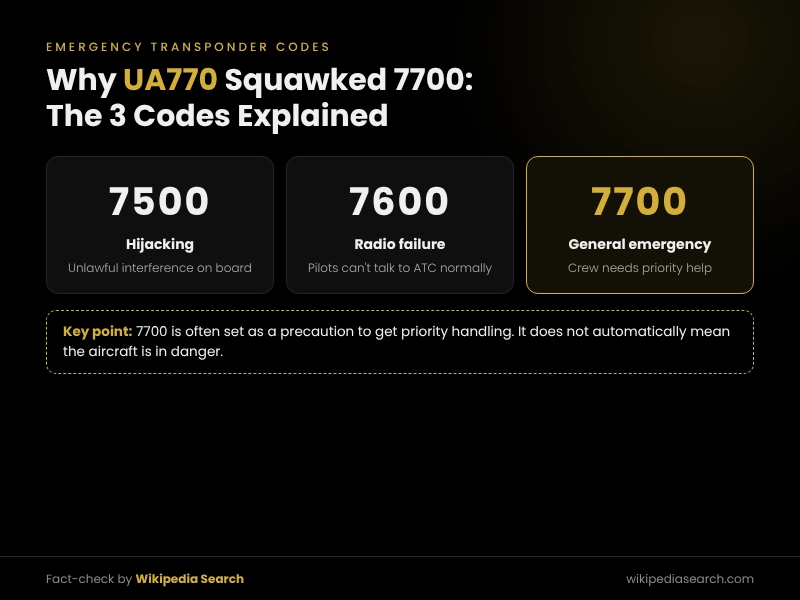
Every airliner has a transponder that broadcasts a four-digit code to air traffic control. Three codes are reserved for special situations:
| Code | Meaning | What it tells controllers |
| 7500 | Unlawful interference (hijacking) | Security emergency on board |
| 7600 | Radio communication failure | Pilots can’t talk to ATC normally |
| 7700 | General emergency | The crew needs priority help |
Here’s the part most articles skip: 7700 does not automatically mean the plane is in danger. Pilots often set it as a precaution so that every controller along the way instantly knows to clear airspace and give priority. A medical case, a warning light or a pressurization alert can all justify it. The FAA’s Aeronautical Information Manual explains how pilots use these emergency transponder codes.
Flight tracking apps such as FlightAware and Flightradar24 highlight 7700 flights in real time, which is often why diversions like UA770 spread on social media within minutes.
Why Heathrow? How Pilots Pick a Diversion Airport
The crew’s exact reasoning hasn’t been published, but diversion airports are generally chosen based on a few practical factors:
- Distance and time. How quickly can the aircraft get on the ground?
- Runway length. A wide-body jet like the 787-9 needs a long runway, and Heathrow has two.
- Engineering support. Can mechanics inspect and repair a 787 on site?
- Airline presence. United runs a large operation at Heathrow, which makes it easier to service the plane and look after passengers.
- Medical facilities. If a medical issue is involved, nearby hospitals matter.
For a flight over Europe heading west toward the Atlantic, Heathrow ticks every box. That explains why it would be a logical choice, even without the crew’s actual decision being public.
If Your Flight Is Diverted: Your Rights and What to Do
This is the part that matters if you fly between the U.S. and Europe. Your rights depend on where the flight departed and why it was disrupted.
EU261: Flights Departing Europe
Because UA770 departed from Barcelona, it fell under EU Regulation 261/2004, which covers all flights leaving an EU airport, including those operated by U.S. airlines like United.
- On flights longer than 3,500 km (Barcelona to Chicago is more than 7,000 km), passengers can be owed up to €600 in compensation if they reach their final destination 4 or more hours late.
- If the delay is caused by “extraordinary circumstances,” such as a passenger’s medical emergency, severe weather or a security issue, the airline doesn’t have to pay compensation.
- Technical problems are usually not considered extraordinary under European court rulings, so a mechanical cause can still mean compensation.
- Regardless of the cause, airlines must provide care during long delays, such as meals, refreshments and a hotel if you’re stuck overnight.
Because the cause of the UA770 emergency hasn’t been published, it’s impossible to say whether its passengers qualified. Full details are on the European Commission’s Your Europe air passenger rights page.
U.S. Rules: Flights Departing the United States
U.S. law doesn’t require cash compensation for delays or diversions. However, under the Department of Transportation’s refund rules, if an airline cancels or significantly changes your flight, including an international delay of 6 hours or more, and you choose not to travel, you’re entitled to a refund. Check the details on the DOT refunds page.
A Simple Checklist If It Happens to You
- Stay calm and follow crew instructions. A diversion means the system is working.
- Keep your boarding pass and booking confirmation.
- Save every receipt for food, transport or hotels.
- Ask the airline for the reason for the diversion in writing, if possible.
- Note your actual arrival time at your final destination, since that decides EU261 compensation.
- File a claim directly with the airline first. You usually don’t need a paid claims company.
How to Spot a Fake or Copy-Paste Flight Incident Story
UA770 is a perfect case study in why you should check before you trust. Watch for these red flags:
- No named sources. Phrases like “reports say” with no airline statement, regulator or reputable outlet linked.
- A confident cause when the airline hasn’t released one.
- “Experts” you can’t verify. A quoted analyst with no organization or record online.
- AI-generated images presented as photos of the aircraft.
- Wrong or shifting dates, especially articles that say “today” about an event from months earlier.
Where to verify instead: the airline’s official newsroom or statement, aviation authorities like the FAA, NTSB or AAIB, flight tracking data from sites like FlightAware, and established aviation news outlets that cite their sources. At Wikipedia Search, we cross-checked every fact in this article against the original report and official sources before publishing.
FAQs
Where did United flight UA770 land after its emergency?
It landed at London Heathrow on runway 27R and taxied to gate B44. It was flying from Barcelona to Chicago O’Hare, so Chicago was its planned destination, not the diversion airport.
What caused the UA770 emergency diversion?
No official cause has been published. United and aviation authorities have not publicly explained why the crew declared an emergency, so specific causes mentioned online remain unconfirmed.
Was anyone hurt on United flight UA770?
No injuries were reported in the available coverage, and the aircraft landed safely. United has not released passenger details or a passenger count.
What does squawk 7700 mean on a United flight?
It is the international transponder code for a general emergency. It gives the flight priority with air traffic control and is often used as a precaution, not only when an aircraft is in serious danger.
Can passengers get compensation for a diverted flight from Europe?
Possibly. Under EU261, passengers arriving 4 or more hours late on long flights from Europe can receive up to €600, unless the disruption was caused by extraordinary circumstances such as a medical emergency.
Fly Smarter With Facts, Not Headlines
You now know what’s actually confirmed about the UA770 diversion, why so many versions of the story disagree, what squawk 7700 really means and what rights you have if your own flight is diverted. Next time an incident trends online, check for a named source before you believe the details.
For more fact-checked news and practical travel guides, explore Wikipedia Search. If someone you know is flying to Europe soon, share this page so they know their rights before they board.
What’s New in This Update
Latest update:
- Rechecked for any new United statement or official investigation report; the cause remains unconfirmed
- Verified the date, route, aircraft and Heathrow landing details against the original incident report
- Confirmed the FAA emergency code guidance and the DOT 6-hour international delay threshold against their official pages
- Added a myth-versus-fact table covering the Chicago and date confusion found online
- Added EU261 and U.S. DOT passenger rights guidance for diverted flights
We review this article regularly and will update it the moment United or an aviation authority publishes the cause of the emergency.
Disclaimer
Wikipedia Search is an independent information website and is not affiliated with United Airlines, the FAA, the NTSB, the AAIB or any airline or regulator. This article is based on publicly available reports and may change if new official information is released. The passenger rights section is general information, not legal advice. Contact your airline or a qualified professional about your specific situation.
About the Author
Govind Kumar writes news explainers and consumer guides for Wikipedia Search. He follows a simple rule: if a claim can’t be traced to a credible source, it doesn’t make it into the article.