

A wide receiver plants his foot to cut upfield, his cleat grips the turf, and his body keeps moving forward while his big toe stays pinned to the ground. He limps to the sideline holding his foot. That is the classic picture of turf toe, and if you have ever wondered what is turf toe exactly, the short version is this: it is a big toe sprain that sounds minor but can sideline an athlete for weeks or even months.
At Wikipedia Search, we dug through guidance from orthopedic surgeons, sports medicine programs and NFL injury research to put everything an athlete, parent or weekend warrior needs in one place: how the injury works, how to tell the grades apart, what recovery really looks like and how to avoid a repeat.
What Is Turf Toe and Why Do Athletes Get It?
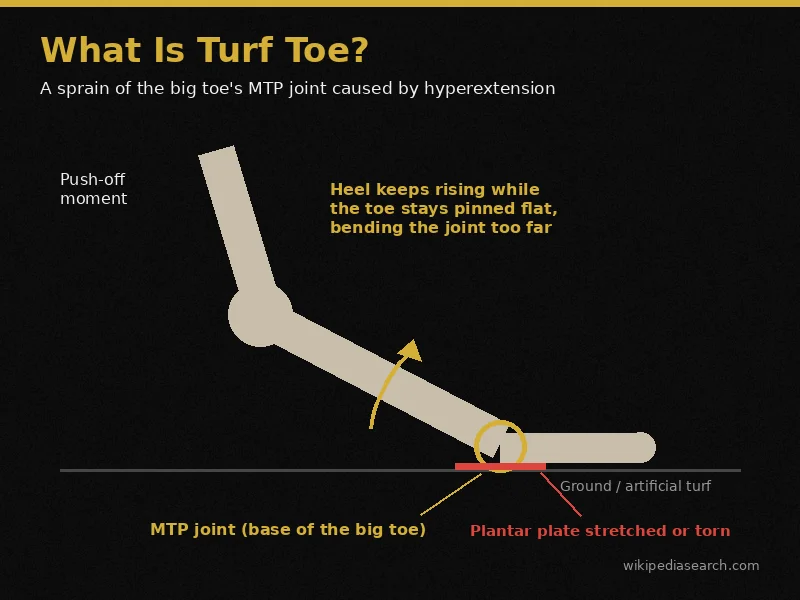
Your big toe has two joints. The one that matters here sits where the toe meets the foot: the metatarsophalangeal joint, usually shortened to the MTP joint. Underneath it is a tough cluster of ligaments, tendons and a thick band called the plantar plate, which together keep the joint stable when you push off.
Turf toe happens when that joint is forced into hyperextension, meaning the toe bends upward far past its normal range. Think of what happens in these moments:
- A running back pushes off for a sprint and his toe stays flat on the ground as his heel rises
- A defender lands on the back of a player’s heel while the player’s toes are planted
- A soccer midfielder jams her foot into the turf while changing direction
- A dancer repeatedly rises onto the balls of her feet during rehearsal
In each case, the soft tissue on the underside of the joint stretches or tears. Doctors call it an MTP joint sprain, but the sports world has used the nickname for decades.
Where the name came from
The term took hold in the 1970s, when American football teams began switching from grass to artificial turf. Early turf was laid over concrete or asphalt, so it was far harder and less forgiving than natural grass, and team doctors started seeing a spike in big toe sprains. Lightweight, flexible football shoes made for fast surfaces added to the problem because they let the toe bend too far.
Today, “turf toe” describes the injury no matter where it happens. A basketball player on hardwood or a wrestler on a mat can get it too.
Turf Toe Grades Explained
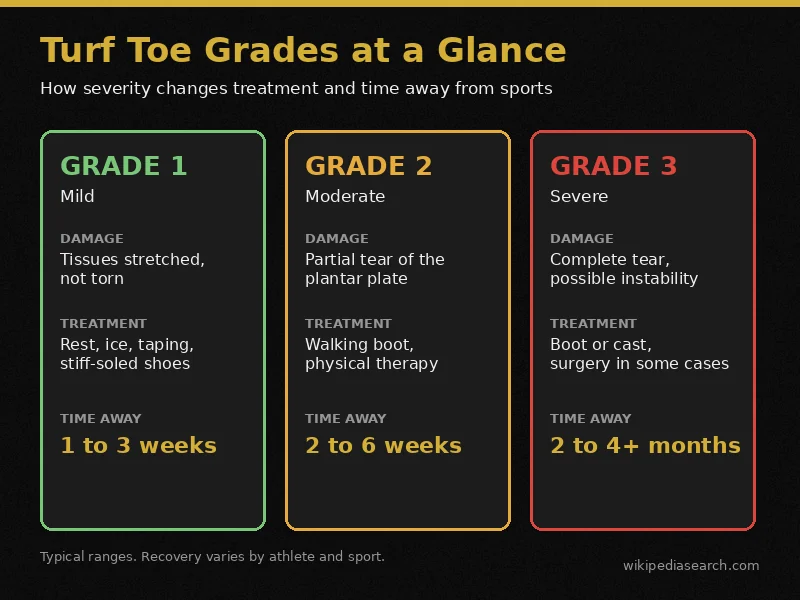
Not every turf toe injury is the same. Doctors use a three-level grading system based on how much damage the plantar complex has taken, and the grade drives almost every treatment decision.
| Grade | What Happened Inside the Joint | What You Feel | Typical Treatment | Typical Time Away From Sports |
| Grade 1 | Tissues stretched, not torn | Mild pain and tenderness, slight swelling, can usually walk normally | Rest, ice, taping, stiffer shoes | About 1 to 3 weeks |
| Grade 2 | Partial tear of the plantar plate or ligaments | Moderate pain, visible swelling and bruising, limping, limited toe motion | Walking boot, rest, physical therapy | About 2 to 6 weeks |
| Grade 3 | Complete tear, sometimes with joint instability or dislocation | Severe pain, heavy swelling and bruising, can barely bear weight on the toe | Boot or cast for weeks, surgery in some cases | About 2 to 4 months, longer after surgery |
You will see slightly different timelines depending on the source. One major Michigan health system says a grade 1 turf toe usually needs two to three weeks of rest, while some foot clinics say most grade 1 symptoms clear in seven to ten days. Both can be true. Pain often fades in about a week, but the ligaments need more time before they can handle full sprinting and cutting again. Going back based on pain alone is one of the most common reasons athletes reinjure the joint.
Is It Turf Toe or Something Else?
Big toe pain has several possible causes, and a few of them look a lot like turf toe in the first 24 hours. Here is how they usually differ.
| Condition | How It Usually Starts | Key Clue |
| Turf toe | Sudden pain during push-off or a tackle | Pain at the base of the big toe that gets worse when you bend it upward |
| Broken toe | Direct impact, like stubbing or something landing on it | Sharp pain at a specific spot on the toe bone, sometimes visible deformity |
| Gout | Often overnight, with no injury at all | Red, hot, intensely painful joint; even a bedsheet touching it hurts |
| Sesamoiditis | Gradual, from repeated pressure (common in dancers and runners) | Aching pain under the ball of the foot rather than at the joint itself |
| Bunion flare-up | Slow buildup over months or years | A bony bump on the side of the joint and pain in tight shoes |
The clearest sign of turf toe is that there was a specific moment when the toe got bent back, and the pain sits right at the base of the big toe. If you are unsure, an X-ray rules out a fracture, and an MRI can show how badly the soft tissue is torn.
Who Is Really at Risk?
Football players get the headlines, but plenty of people who never touch a gridiron end up with this injury.
Field sport athletes. Football, soccer, lacrosse, rugby and field hockey players are at the top of the list because of constant sprinting, cutting and pile-ups.
Dancers and gymnasts. Ballet, in particular, puts the big toe joint through repeated extreme bending. Here the injury often builds gradually rather than happening in one moment.
Wrestlers and martial artists. Pushing off a mat with bare feet loads the MTP joint with no shoe support at all.
Gym-goers. This is the group most articles skip. Many US gyms now have strips of artificial turf for sled pushes, sprints and box jumps. If you are doing high-intensity interval training on turf in flexible running shoes, your big toe is under the same kind of stress as a football player’s.
People with certain foot shapes. Doctors note that people with bunions or less natural range of motion in the big toe tend to be more prone to it.
Anyone in soft, flexible shoes. Shoes that bend easily at the forefoot let the toe hyperextend. That is why footwear shows up in almost every prevention plan.
Artificial Turf vs Grass: What the NFL Data Shows
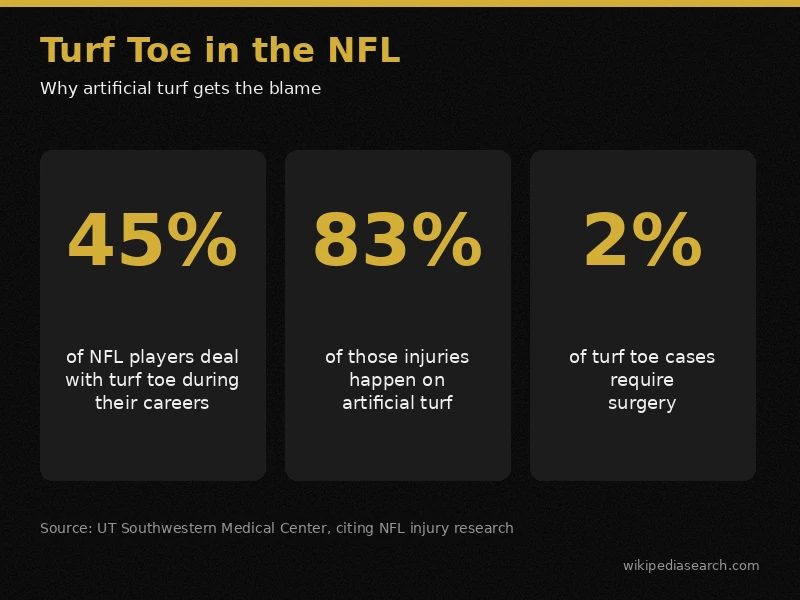
This is where the injury gets its reputation. According to UT Southwestern Medical Center, one study found that up to 45% of NFL players have dealt with turf toe during their careers, and 83% of those injuries happened on artificial turf. The same source notes that only about 2% of cases required surgery.
That data feeds one of the loudest debates in American sports. When Aaron Rodgers tore his Achilles tendon just four snaps into his New York Jets debut on the artificial turf at MetLife Stadium in September 2023, the NFL Players Association renewed its push for natural grass in every stadium. Players have long argued that turf is harder on feet, ankles and knees, even though the league points to studies showing modern turf has narrowed the gap.
The 2026 FIFA World Cup gave the debate a real-world test. FIFA required natural grass for every match, so several NFL stadiums that normally use artificial turf installed temporary grass fields for the tournament. For athletes, the takeaway is practical: if you regularly play or train on turf, your big toe injury risk is higher, and footwear and taping matter more.
Turf Toe Treatment and Recovery Timeline
Most people with turf toe heal without surgery. The goal of treatment is simple: protect the joint so the torn or stretched tissue can heal in the right position, then rebuild strength and motion.
The first 48 to 72 hours
- Rest the foot and stop the activity that caused the pain
- Ice the joint for 15 to 20 minutes at a time, a few times a day
- Compress with a light wrap and elevate the foot above heart level
- Use over-the-counter pain relievers if your doctor says they are safe for you
Protecting the joint while it heals
For grade 1 turf toe, turf toe taping and a stiff-soled shoe are often enough. The tape limits how far the toe can bend upward. For grade 2, many doctors use a walking boot for one to two weeks so you can move around without loading the joint. Grade 3 injuries may need a boot or cast for several weeks.
Physical therapy
Once swelling settles, a physical therapist gradually restores range of motion, then works on toe and foot strength, balance and finally sport-specific movements like push-offs and cutting. Skipping this phase is how a grade 1 sprain turns into a chronic problem.
When surgery is considered
Surgery is usually reserved for complete plantar plate tears, an unstable joint, a fractured sesamoid bone, loose pieces of cartilage, or cases where the toe has not improved after a solid run of conservative treatment. Recovery after surgery often takes four to six months before full return to competitive sports.
Return to Play Checklist
Use this as a conversation guide with your doctor, physical therapist or athletic trainer, not as a substitute for their clearance. Athletes are usually ready when they can:
- Walk and climb stairs with no pain and no limp
- Bend the big toe upward close to its normal range without sharp pain
- Rise up onto the balls of both feet repeatedly, with equal strength on each side
- Jog, then sprint in a straight line without pain the next day
- Cut, pivot and push off hard during practice drills without favoring the foot
- Practice fully with tape or a stiff insole for at least a few sessions before returning to games
If pain or swelling comes back at any stage, step back to the previous one.
How to Prevent Turf Toe
You cannot eliminate the risk, especially in contact sports, but these steps make a measurable difference.
Choose stiffer shoes. Cleats or training shoes with a firm forefoot resist the upward bending that causes the injury. Do the “bend test” in the store: if the shoe folds easily at the toes, it offers little protection.
Try a turf toe insole. Rigid inserts, including carbon fiber plates, slide into regular shoes and stop the toe from hyperextending. Many college and NFL athletes wear them after an injury.
Tape before high-risk activity. If you have had turf toe before, taping before games and hard practices limits extreme motion.
Strengthen your feet. Toe curls, towel scrunches, short-foot exercises and calf raises build the muscles that support the MTP joint.
Respect the surface. If you have a choice between training on turf or grass, and your toe is still recovering, choose grass.
When to See a Doctor
Mild sprains often settle with home care, but get checked by a doctor, podiatrist or sports medicine specialist if you notice:
- You cannot put weight on the toe or walk normally
- The toe looks deformed or feels loose and unstable
- Swelling and bruising are spreading or getting worse after 48 hours
- Pain has not improved after a week of rest
- You feel numbness or tingling in the toe
- The pain returns every time you try to play
Leaving a moderate or severe turf toe injury untreated can lead to long-term stiffness, a condition called hallux rigidus, and early arthritis in the big toe joint. Those problems are much harder to fix than the original sprain.
Frequently Asked Questions
Can you walk with turf toe?
Most people with grade 1 turf toe can walk, though pushing off feels sore. With grade 2 or 3, walking is often painful and you may limp. If walking hurts, a walking boot or stiff-soled shoe lets you get around while the joint heals.
How long does turf toe take to heal?
Mild cases usually take 1 to 3 weeks, moderate cases 2 to 6 weeks, and severe tears 2 to 4 months or longer. After surgery, expect four to six months before full return to competitive sports.
Can turf toe heal on its own?
A mild turf toe sprain often heals with rest, ice and protection. Moderate and severe injuries need proper protection, sometimes a boot, and usually physical therapy. Playing through it is what turns a short recovery into a long one.
Do you need a boot for turf toe?
Not always. Grade 1 injuries usually do fine with taping and stiff shoes. Doctors commonly recommend a walking boot for grade 2 injuries and a boot or cast for grade 3.
Is turf toe the same as a sprained toe?
Yes, it is a specific type of sprain. Turf toe refers to a sprain of the big toe’s MTP joint caused by hyperextension, rather than a sprain of the smaller toes or other joints.
Can you get turf toe without playing sports?
Yes. Any activity that bends the big toe sharply upward with your heel off the ground can cause it, from gym workouts on turf to slipping on stairs or dancing.
Get the Full Picture Before You Get Back Out There
A turf toe diagnosis does not have to wreck a season if you treat it early and return gradually. Bookmark this guide, share it with a teammate or your kid’s coach, and explore more sports and health explainers on Wikipedia Search to stay ahead of the injuries that sideline athletes most.
<!– Internal link placeholders: add 2 to 3 related posts from the Sports & Travel and Health & Lifestyle categories here, e.g. ankle sprain recovery, best running shoes, sports injury prevention –>
Trusted sources used in this guide:
- Turf Toe, OrthoInfo by the American Academy of Orthopaedic Surgeons
- Turf toe: What athletes need to know, UT Southwestern Medical Center
- Turf Toe, Cleveland Clinic
Disclaimer
This article is for general informational purposes only and is not medical advice. It does not replace diagnosis or treatment from a qualified healthcare professional. If you have a foot or toe injury, consult a doctor, podiatrist or sports medicine specialist before making treatment or return-to-play decisions.